Cheapest Online Colleges 2027: Real Prices After Aid
The cheapest online college in our 2027 ranking is University of Florida Online, where students pay an average of $4,336 a year after grants and scholarships. The University of Texas Permian Basin ($5,070) and Elizabeth City State University ($8,048) follow, and all ten schools on the list cost $10,237 a year or less. We rank by average net price in U.S. Department of Education data, and every school offers at least five bachelor's degrees fully online. Most of these prices are for in-state students, so if you live in another state, start with the schools that post one online rate for everyone, such as UT Permian Basin at $219.22 per credit.
Need to Know
- University of Florida Online has the lowest price after aid, $4,336 a year on average, and 83% of its students graduate.
- All ten schools cost $10,237 a year or less after aid. UT Permian Basin is second at $5,070.
- UF Online graduates earn a median of $76,194 five years after finishing. Weber State ($69,459) and Florida State ($69,241) come next.
Average net price is the yearly cost of tuition, fees, books and living costs, minus grants and scholarships. The U.S. Department of Education reports it for first-time, full-time students who received aid, and at public schools it covers in-state students only. It is a school-wide average, so use it to compare schools, then check the online rate for your own state on each card below. Net prices, graduation rates and earnings come from the department's October 2026 data. Tuition rates come from each school's own tuition page, read in November 2026.
The 10 schools at a glance
| Rank | School | Location | Average Net Price |
|---|---|---|---|
| 1 | University of Florida Online | Gainesville, FL | $4,336 |
| 2 | University of Texas Permian Basin | Odessa, TX | $5,070 |
| 3 | Elizabeth City State University | Elizabeth City, NC | $8,048 |
| 4 | Fayetteville State University | Fayetteville, NC | $8,500 |
| 5 | Florida State University | Tallahassee, FL | $8,605 |
| 6 | Clayton State University | Morrow, GA | $8,868 |
| 7 | University of West Florida | Pensacola, FL | $9,443 |
| 8 | University of Arkansas Grantham | Little Rock, AR | $9,940 |
| 9 | Baker College | Owosso, MI | $10,115 |
| 10 | Weber State University | Ogden, UT | $10,237 |
Average net price is the average yearly cost after grants and scholarships for first-time, full-time students who received aid. U.S. Department of Education data, October 2026.
Quick picks
What are the 10 cheapest online colleges for 2027?
The ten schools below cost $4,336 to $10,237 a year after aid. Nine are public universities and one, Baker College, is a private nonprofit. Each school graduates at least 40% of its students or keeps at least 70% of them after the first year, and each lists at least five bachelor's degrees you can finish fully online. Two of them, Fayetteville State and Florida State, only admit transfer students to their online programs, so read the "Who can enroll" line on each card. Eight of the ten are new this year, and you can see what changed from our 2026 ranking. See how EDsmart ranks schools.
University of Florida Online
University of Florida Online is the online campus of Florida's flagship public university in Gainesville. It lists 27 majors, from anthropology to computer science, and says every bachelor's program is built to be finished fully online. First-year students can start here, so you don't need transfer credits to get in. The federal data counts UF Online as its own school, so the $4,336 average describes online students, not the Gainesville campus.
Location: Gainesville, FL
Online rate: $129.18 per credit for Florida residents and $552.62 for everyone else, with required fees. UF Online's tuition page lists these rates as unchanged for 2025–26.
Who can enroll: First-year and transfer students.
Best for: Florida residents who want a full four-year degree online at the lowest price on this list.
Tuition page: UF Online tuition and fees
Online degrees: UF Online online programs
Median federal loan debt at graduation: $13,496
Undergraduates: 4,627
University of Texas Permian Basin
University of Texas Permian Basin sits in Odessa, in the West Texas oil country it is named for, and belongs to the University of Texas System. Its online campus lists 17 bachelor's degrees, including accounting, psychology, criminology and industrial technology. The draw for students outside Texas is the price rule: online students pay the same rate in every state. Graduation is the weak spot. About 41% of students finish, just over our floor.
Location: Odessa, TX
Online rate: $219.22 per credit in every state. With fees, 12 credits cost $3,963.
Who can enroll: First-year and transfer students for most majors. The RN to BSN and two applied degrees need a nursing license or an associate degree.
Best for: Out-of-state students who want a public university price without residency rules.
Tuition page: UT Permian Basin tuition and fees
Online degrees: UT Permian Basin online programs
Median federal loan debt at graduation: $19,000
Undergraduates: 3,911
Elizabeth City State University
Elizabeth City State University is a small public, historically Black university in northeastern North Carolina and part of the UNC System. It lists seven bachelor's degrees as 100% online, including aviation science, criminal justice, homeland security, social work and history. North Carolina residents pay $500 a semester in tuition. Confirm one thing before you apply: the school's distance tuition page names only homeland security and interdisciplinary studies for the distance rate, so ask which rate your major gets.
Location: Elizabeth City, NC
Online rate: $500 a semester for North Carolina residents and $3,500 for non-residents, for 12 to 18 credits. With fees, that is $1,071.50 and $4,071.50.
Who can enroll: First-year and transfer students.
Best for: North Carolina residents who want a low, flat price each semester.
Tuition page: Elizabeth City State tuition and fees
Online degrees: Elizabeth City State online programs
Median federal loan debt at graduation: $20,745
Undergraduates: 1,975
Fayetteville State University
Fayetteville State University is a public, historically Black university in Fayetteville, North Carolina, near Fort Bragg. Its 16 online majors are degree-completion programs. You bring at least 30 transferable credits, usually your general education courses, and finish the rest online. Majors include business administration, computer science, cybersecurity, criminal justice, psychology and an RN to BSN. The $8,500 average comes from first-year campus students, so treat it as a guide to the school, not a quote for the online program.
Location: Fayetteville, NC
Online rate: $500 a semester for North Carolina residents and $3,500 for non-residents at 12 credits. With fees, that is $1,119 and $4,119.
Who can enroll: Transfer students only. You need at least 30 transferable credits.
Best for: North Carolina residents with community college or military credits who want to finish a bachelor's degree.
Tuition page: Fayetteville State tuition and fees
Online degrees: Fayetteville State online programs
Median federal loan debt at graduation: $20,500
Undergraduates: 5,762
Florida State University
Florida State University in Tallahassee has the highest graduation rate on this list, 86%. Its online lineup is short and built for transfers: six bachelor's degrees in computer science, criminology, emergency management and intelligence studies, interdisciplinary social science, and public safety and security. You need 60 or more transferable credits to get in, so most students arrive with an associate degree. The $8,605 average comes from first-year campus students, so use it as a guide to the school, not a quote for the online program.
Location: Tallahassee, FL
Online rate: $180.49 per credit for Florida residents and $820.01 for non-residents, plus a distance learning fee that varies by course.
Who can enroll: Transfer students only. You need 60 or more transferable credits.
Best for: Florida residents with an associate degree who want to finish at a large state university.
Tuition page: Florida State tuition and fees
Online degrees: Florida State online programs
Median federal loan debt at graduation: $13,000
Undergraduates: 32,212
Clayton State University
Clayton State University is a public university in Morrow, Georgia, just south of Atlanta. It sets a special e-tuition rate for fully online majors, and its rate sheet shows a single price with no in-state or out-of-state split. Nineteen bachelor's majors are on that sheet, including accounting, management, psychology, history, legal studies and an RN to BSN. Two cautions: some majors are completion programs, and the school says you may have to take proctored exams in person.
Location: Morrow, GA
Online rate: $176 per credit plus a $308 online learning fee each term. That is $2,420 for 12 credits.
Who can enroll: Varies by major. Several are completion programs, so ask whether you can start your major online as a first-year student.
Best for: Students in any state who want a low posted rate from a public university.
Tuition page: Clayton State tuition and fees
Online degrees: Clayton State online programs
Median federal loan debt at graduation: $25,250
Undergraduates: 4,348
University of West Florida
University of West Florida is a public university in Pensacola, on the Gulf Coast in Florida's Panhandle. It lists 23 online bachelor's programs, with a deep business lineup (accounting, finance, management, supply chain) plus health sciences, psychology and an RN to BSN. First-year students can enroll in the online programs. If you live outside Florida, ask about the out-of-state waiver. It cuts the rate from $714.03 to $361.32 a credit, and you have to request it every semester.
Location: Pensacola, FL
Online rate: $220.23 per credit for Florida residents and $325.23 for Alabama residents, fees included.
Who can enroll: First-year and transfer students. The RN to BSN needs a nursing license.
Best for: Florida and Alabama residents who want a wide choice of business majors.
Tuition page: West Florida tuition and fees
Online degrees: West Florida online programs
Median federal loan debt at graduation: $15,139
Undergraduates: 9,330
University of Arkansas Grantham
University of Arkansas Grantham is the fully online campus of the University of Arkansas System, based in Little Rock. Every program is 100% online, courses run eight weeks, and new classes start each month. It offers 11 bachelor's degrees and posts one rate for every state. Know two things first. Only 30% of first-year students come back for a second year, the lowest retention rate on this list. And its accreditor is the Distance Education Accrediting Commission, so if you might transfer later, ask the next school whether it takes UA Grantham credits.
Location: Little Rock, AR
Online rate: $305 per credit plus a $50 per credit resource fee that covers textbooks. Military members and veterans pay $250 per credit.
Who can enroll: New and transfer students. There is no application fee.
Best for: Working adults and service members who want monthly start dates.
Tuition page: UA Grantham tuition and fees
Online degrees: UA Grantham online programs
Median federal loan debt at graduation: $19,588
Undergraduates: 2,833
Baker College
Baker College is a private nonprofit college in Michigan and the only private school in our ten. Online courses run in eight-week sessions, and Baker marks 22 bachelor's degrees as having their core courses online, in fields like accounting, computer science, cybersecurity, criminal justice and psychology. Its posted rate is the highest here, $465 a credit in every state. It makes the list on price after aid: Baker says its full-time undergraduates paid an average of $212 a credit in fall 2025. Get your aid offer before you judge the price.
Location: Owosso, MI
Online rate: $465 per credit in every state, plus a $350 technology fee each semester.
Who can enroll: First-year and transfer students. Baker accepts up to 90 transfer credits.
Best for: Transfer students with a lot of credits who qualify for Baker's grants and scholarships.
Tuition page: Baker College tuition and fees
Online degrees: Baker College online programs
Median federal loan debt at graduation: $25,500
Undergraduates: 3,026
Weber State University
Weber State University is a large public university in Ogden, Utah, north of Salt Lake City. It lists 19 online bachelor's programs, and nine program pages call the degree fully online, including computer science, criminal justice, English, health administration and professional sales. Most online-only students from other states pay the in-state tuition rate. Check your major first: Weber State says some programs need in-person work and that online general education courses are limited.
Location: Ogden, UT
Online rate: $5,768 a year in tuition for your first 60 credits, plus $811 in student fees. Most online-only students from other states pay this same rate.
Who can enroll: Varies by program. Some degrees are for licensed nurses or paramedics.
Best for: Out-of-state students in health fields who want in-state pricing.
Tuition page: Weber State tuition and fees
Online degrees: Weber State online programs
Median federal loan debt at graduation: $15,298
Undergraduates: 16,360
Retention is the share of first-year students who return for a second year. Median earnings are for graduates five years after finishing. All four figures are school-wide, from U.S. Department of Education data.
Six more schools passed every test and sit just above the cut: Florida Atlantic University ($10,394), Southern Utah University ($10,887), American Public University System ($11,116), SUNY Empire State University ($11,131), Florida International University ($11,462) and the University of Central Florida ($11,516).
Which cheap online colleges charge the same price in every state?
Seven schools that passed our tests post one online rate for everyone, or give most online-only students the in-state rate. If you live outside a school's home state, this table matters more than the ranking above, because public university net prices describe in-state students. We sorted it by what 12 credits cost with required fees.
| School | Posted online rate | 12 credits with fees |
|---|---|---|
| Clayton State University | $176 per credit plus a $308 fee each term | $2,420 |
| Weber State University | $5,768 a year plus $811 in fees (first 60 credits) | About $3,290 |
| Fort Hays State University | $275.65 per credit, fees included | $3,308 |
| University of Texas Permian Basin | $219.22 per credit plus fees | $3,963 |
| University of Arkansas Grantham | $305 per credit plus a $50 resource fee | $4,260 |
| American Public University System | $360 per credit, no technology fee | $4,320 |
| Baker College | $465 per credit plus a $350 fee each semester | $5,930 |
Rates are the current ones on each school's tuition page, read in November 2026. Clayton State's sheet lists one rate for fully online majors. Weber State's rate covers most online-only students from other states, and its 12-credit figure is half of a full-time year. Books are extra except at UA Grantham.
Two notes on this group. Fort Hays State has the third-lowest posted cost here, but its average net price is $16,333, so it is not in our ten. American Public University System ($11,116) is a for-profit school owned by American Public Education, Inc. Western Governors University (WGU) ($12,748) also charges one flat rate per six-month term in every state and says its bachelor's tuition averages $8,300 a year. Its rates changed in October 2026, so check the tuition page for your program.
Why isn't the lowest tuition always the lowest cost?
Because posted tuition is the price before aid, and it leaves out books and living costs. Average net price counts all of those costs and then subtracts grants and scholarships. The two numbers can point in different directions, so here are both for our ten schools.
| School | Posted online rate | Average net price |
|---|---|---|
| University of Florida Online | $129.18 per credit (Florida residents) | $4,336 |
| University of Texas Permian Basin | $219.22 per credit (every state) | $5,070 |
| Elizabeth City State University | $500 a semester (North Carolina residents) | $8,048 |
| Fayetteville State University | $500 a semester (North Carolina residents) | $8,500 |
| Florida State University | $180.49 per credit (Florida residents) | $8,605 |
| Clayton State University | $176 per credit (one rate on the sheet) | $8,868 |
| University of West Florida | $220.23 per credit (Florida residents) | $9,443 |
| University of Arkansas Grantham | $305 per credit (every state) | $9,940 |
| Baker College | $465 per credit (every state) | $10,115 |
| Weber State University | $5,768 a year (Utah residents and most online-only students) | $10,237 |
Posted rates are tuition before fees, except at UF Online, Florida State and West Florida, where the rate includes required fees. Average net price is a yearly, school-wide figure from U.S. Department of Education data.
Baker College shows the gap best. It posts the highest rate in the table, $465 a credit, yet its students pay $10,115 a year on average after aid. Elizabeth City State shows the other side. Tuition for North Carolina residents is $1,000 a year, but average net price is $8,048 because it counts fees, books and living costs.
This is also why two schools that other lists rank for low tuition are missing here. Fort Hays State charges $275.65 a credit and Kennesaw State charges $192, but their average net prices are $16,333 and $16,325. Neither number is your price. Use net price to build a short list, then use the posted rate for your state and each school's net price calculator to work out your own bill.
What do SNHU, Liberty and other big online schools charge?
Between $354 and $580 a credit for 2026–27, which comes to about $42,000 to $70,000 in tuition for a 120-credit bachelor's degree before aid and transfer credits. That is more than in-state public options and close to what some schools on our list post.
| School | Posted online rate | Tuition for a full bachelor's |
|---|---|---|
| Southern New Hampshire University | $354 per credit | $42,480 |
| Liberty University | $410 per credit full-time, $475 part-time | $49,200 |
| Grand Canyon University | $490 per credit for most programs | $58,800 |
| Purdue University Global | $371 per quarter credit | $66,780 |
| Arizona State University Online | $580 per credit plus program fees | $69,600 |
2026–27 online undergraduate rates from each school's tuition page. Totals are the posted rate times 120 credits (180 quarter credits at Purdue Global), before fees, aid and transfer credits.
For comparison, 120 credits at UF Online's Florida resident rate cost $15,502. SNHU's $354 is lower than Baker's posted rate and about the same as UA Grantham's $355 with its resource fee, so on posted price SNHU sits in the middle of the pack.
The gap shows up after aid. Average net price is $36,764 a year at SNHU, $29,235 at Liberty and $21,509 at Grand Canyon, against $10,237 or less at our ten. Those averages cover first-time, full-time students and include living costs, so treat them as a rough guide if you plan to study part-time from home. Purdue Global has no average net price in the federal data. It is a separate online university in the Purdue system, with its own tuition and its own results.
Can you earn an online bachelor's degree for about $10,000 or less?
Yes. Three schools post a total price at or near that mark, and each comes with a trade-off.
- Newlane University: $3,000 for a full bachelor's degree, or $1,500 if you already hold an associate degree. You pay $249 to start, then $39 a month. Degrees are in philosophy and liberal arts only. Newlane is accredited by the Distance Education Accrediting Commission and does not take federal aid.
- University of the People: no tuition. You pay a $60 application fee and $180 for each course, which the school totals at $7,260 for a business or computer science degree. It offers four bachelor's degrees, is accredited by the WASC Senior College and University Commission, and does not take federal aid.
- University of Maine at Presque Isle, YourPace: $1,800 for each eight-week session, however many courses you finish. The school says a bachelor's degree costs $10,200 or less. The price is the same in every state and federal aid applies. It is not in our ranking because 39% of students graduate and 58% return after the first year, both under our floor.
Two public colleges are worth a look if you live in their state. Indian River State College charges Florida residents $117.10 a credit for bachelor's-level courses, and Great Basin College charges Nevada residents $226 a credit plus an $11.50 technology fee. Each offers only a handful of bachelor's degrees online. Newlane, University of the People and these two colleges have no average net price in the federal data, so we could not rank them. For more options, see our guides to tuition-free online colleges and how accreditation types differ.
How did we rank the cheapest online colleges?
We sorted schools by average net price, lowest first, after five tests. We started with 87 schools named in Google's answers, in other rankings and in reader forums. Twenty-two passed every test, and the ten with the lowest net price are the ranking.
- Price data. The school has an average net price in the U.S. Department of Education's October 2026 data.
- Quality floor. At least 40% of students graduate, or at least 70% return after the first year.
- Size. At least 1,000 undergraduates, and not a seminary or Bible college.
- Usable rates. We set aside schools whose graduation or retention rate was missing or a placeholder.
- A real online lineup. The school's own site lists at least five bachelor's degrees you can finish fully online.
The floor is why some low prices are missing. Eastern New Mexico University has an average net price of $5,238, but 39% of its students graduate and 62% return, so it did not qualify.
Net price has limits, and we would rather say so. It is a school-wide average, not an online-only figure, except at UF Online. It covers first-time, full-time students who received aid, and at public schools it covers in-state students. Transfer and part-time students are not in it. We do not accept payment for placement, and sponsored listings never appear in our tables.

The ten schools that method produced, ordered by average net price. Shorter bars cost less. Select the chart to open a larger view.
What changed from our 2026 ranking?
Eight of the ten schools are new. Only UF Online, still first, and Weber State, now tenth, return from our 2026 ranking. Three things caused it: the federal data moved prices, one school fell under our quality floor, and we checked many more schools this year.
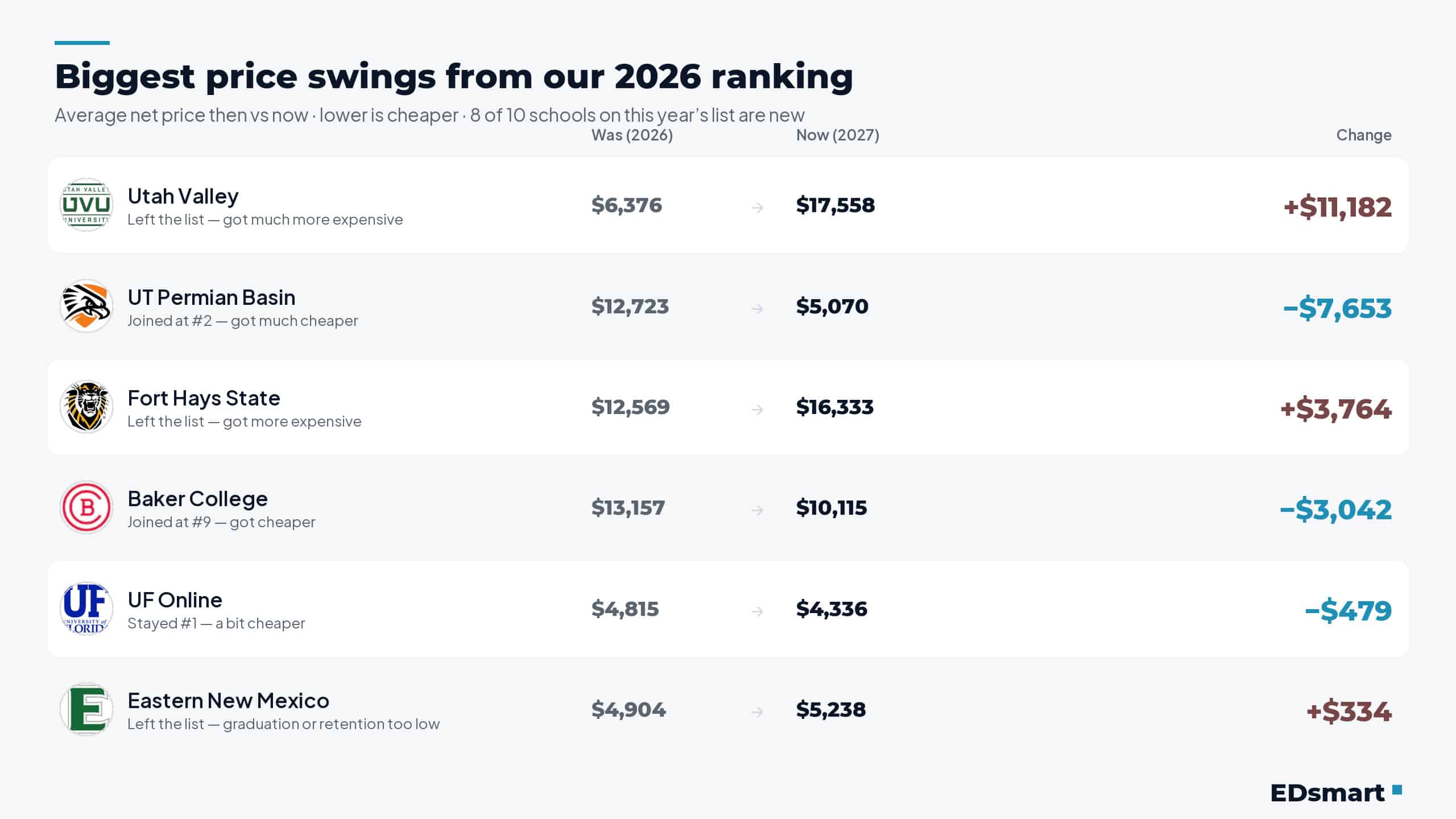
Biggest average-net-price moves between our 2026 and 2027 rankings. Teal change = got cheaper; warm change = got more expensive. Select the chart to open a larger view.
| School | 2026 ranking | 2027 ranking |
|---|---|---|
| University of Florida Online | #1, $4,815 | #1, $4,336 |
| University of Texas Permian Basin | Not ranked, $12,723 | #2, $5,070 |
| Elizabeth City State University | Not ranked, $6,364 | #3, $8,048 |
| Fayetteville State University | Not ranked, $7,892 | #4, $8,500 |
| Florida State University | Not ranked, $11,297 | #5, $8,605 |
| Clayton State University | Not ranked, $8,365 | #6, $8,868 |
| University of West Florida | Not ranked, $9,364 | #7, $9,443 |
| University of Arkansas Grantham | Not ranked, $8,370 | #8, $9,940 |
| Baker College | Not ranked, $13,157 | #9, $10,115 |
| Weber State University | #6, $10,258 | #10, $10,237 |
| Eastern New Mexico University | #2, $4,904 | Not ranked, $5,238 |
| Utah Valley University | #3, $6,376 | Not ranked, $17,558 |
| Florida International University | #4, $9,288 | Not ranked, $11,462 |
| American Public University System | #5, $9,597 | Not ranked, $11,116 |
| University of Central Florida | #7, $10,411 | Not ranked, $11,516 |
| Southern Utah University | #8, $10,462 | Not ranked, $10,887 |
| Western Governors University | #9, $12,548 | Not ranked, $12,748 |
| Fort Hays State University | #10, $12,569 | Not ranked, $16,333 |
Each cell shows the school's place in that year's ranking and its average net price in the data we used. The 2026 ranking used the U.S. Department of Education's June 2026 data. This ranking uses its October 2026 data.
- Prices moved in the new data. Average net price rose at eight of last year's ten schools. The biggest jumps were at Utah Valley University ($6,376 to $17,558) and Fort Hays State ($12,569 to $16,333). Two schools moved the other way and joined the list: UT Permian Basin ($12,723 to $5,070) and Baker College ($13,157 to $10,115). Their graduation rates also rose past our 40% floor.
- One school fell under the quality floor. Eastern New Mexico University was second last year and still has a low price, $5,238. But its graduation rate fell from 45% to 39%, and 62% of first-year students return, so it no longer passes.
- We checked more schools. Last year's list started from a shorter set of schools. This year we started from 87 and read each school's site to count its fully online bachelor's degrees. That brought in six schools that were already priced under last year's cut: Elizabeth City State, Fayetteville State, Florida State, Clayton State, West Florida and UA Grantham. They are new because we looked wider, not because they got cheaper. Five of the six cost more in the new data, and only Florida State's price fell.
The result is a lower cut. The tenth school now costs $10,237 a year, down from $12,569. Six of last year's schools still pass every test and are priced above it: Southern Utah ($10,887), American Public University System ($11,116), Florida International ($11,462), Central Florida ($11,516), Western Governors ($12,748) and Fort Hays State ($16,333).
One year's average can swing a lot. Utah Valley's figure nearly tripled and UT Permian Basin's fell by more than half between two sets of federal data. Treat any school's average net price as a starting point, and run the school's net price calculator with your own numbers before you decide.
What fees should you check before you enroll?
Check the required fees, because a low per-credit rate can hide them. Clayton State adds $308 each term. Baker College adds $350 each semester. UA Grantham adds $50 a credit, which covers textbooks. Florida State adds a distance learning fee that varies by course. Kennesaw State pairs its $192 rate with a $594 fee each term. Ask every school three questions before you apply:
- What do 12 credits cost with every required fee?
- Is that the rate for students in my state?
- Are exams proctored, and is there a cost or a trip involved?
How can you pay less for an online degree?
Start with public universities in your own state, then stack aid and transfer credits on top. These five steps do the most.
- Use your in-state rate. Residents pay $129.18 a credit at UF Online and $500 a semester at Elizabeth City State and Fayetteville State. Few national schools come close.
- File the FAFSA. The Federal Pell Grant pays up to $7,395 for 2026–27, and online students qualify the same way campus students do. See our list of online colleges that accept FAFSA.
- Bring credits with you. Community colleges charge an average of $4,210 a year in tuition and fees, according to the College Board. Florida State and Fayetteville State are built for transfer students, and Baker accepts up to 90 credits.
- Avoid the out-of-state rate. Pick a school with one price for everyone, or ask about a waiver like West Florida's.
- Ask about military rates. UA Grantham, American Public University System, SNHU and Liberty all charge $250 a credit for eligible service members.
Does it matter if a school is public, nonprofit or for-profit?
It matters less than the price after aid and the graduation rate, but it explains a lot about price. Public universities get state funding, which is why residents pay less and why nine of our ten are public. Baker College is a private nonprofit. For-profit schools are not automatically a bad choice. American Public University System passed every test we set and landed just above the cut at $11,116. Whatever the type, look up the school in the Department of Education's accreditation database and compare its graduation rate with the schools above.
Where can you find cheap online colleges for your state or degree level?
In-state rates decide most of the price, so your own state is the best place to look next.
- By state: Florida, Texas, North Carolina, Georgia, Michigan, New York, Ohio, Illinois, Pennsylvania, Virginia, Tennessee, Indiana, Maryland, New Jersey, Washington.
- Master's degrees: see the most affordable online master's programs.
- Doctorates: start with the shortest online doctoral programs.
- Certificates: if a degree is more than you need, see 6-month certificate programs that pay well.
Cheap online colleges: common questions
What is the cheapest online college?
University of Florida Online has the lowest price after aid in our 2027 ranking. Students there pay an average of $4,336 a year after grants and scholarships, and Florida residents pay $129.18 a credit with required fees. The University of Texas Permian Basin is second at $5,070 and charges the same online rate in every state.
Which online college costs the least for out-of-state students?
Look for a school that posts one online rate for every state. In our comparison, Clayton State University has the lowest cost for 12 credits with fees, $2,420, followed by Weber State University, Fort Hays State University and the University of Texas Permian Basin. Confirm the rate for your state before you apply, because Weber State's applies to most online-only students, not all.
Do online students pay out-of-state tuition?
Often, yes. UF Online charges non-residents $552.62 a credit against $129.18 for Florida residents, and Florida State charges $820.01 against $180.49. Other schools post one rate for everyone, including UT Permian Basin, UA Grantham and Baker College.
Are cheap online colleges accredited?
The ten schools in our ranking are, and each takes part in federal student aid. A low price doesn't tell you either way, so look up any school in the Department of Education's accreditation database before you apply.
Can you get an online degree for free?
Not quite. University of the People charges no tuition, but its fees add up to $7,260 for a business or computer science degree, and it does not take federal aid. A Pell Grant, worth up to $7,395 for 2026–27, can cover tuition at the lowest-priced public schools on this page, such as the $1,000 a year North Carolina residents pay at Elizabeth City State.
How much does an online bachelor's degree cost?
It depends mostly on where you live. At posted rates, tuition for 120 credits is $15,502 at UF Online for Florida residents, $42,480 at SNHU and $69,600 at ASU Online, before aid and transfer credits. Public four-year colleges charge in-state students an average of $12,290 a year in tuition and fees, according to the College Board.
What is the least expensive way to earn a bachelor's degree online?
Start at a community college, then transfer to a public university in your own state. Community college tuition and fees average $4,210 a year, and schools like Florida State and Fayetteville State build their online programs around transfer students. File the FAFSA each year so grants come off the bill first.
Which cheap online college is best for working adults?
Pick by what you already have. With no college credits, UA Grantham starts classes every month and runs eight-week courses, and UF Online takes first-year students. With an associate degree or about 60 credits, Florida State and Fayetteville State are built for finishing. Baker College accepts up to 90 transfer credits.
Which cheap online college should you pick?
Start with where you live. In Florida, UF Online is the clear first choice at $4,336 a year after aid, and Florida State and West Florida are strong if you already have credits or want a business major. In North Carolina, Elizabeth City State and Fayetteville State charge residents $500 a semester. Anywhere else, compare the one-rate schools on what 12 credits cost, starting with Clayton State and UT Permian Basin. Then get your own number from each school's net price calculator, because an average is only a starting point.
Sources
- U.S. Department of Education: average net price, graduation rate, retention rate and median earnings, October 2026 data
- Tuition and fee pages of each school named in this guide, read in November 2026
- Federal Student Aid: Federal Pell Grant maximum award for 2026–27
- College Board: Trends in College Pricing 2026
- EDsmart rankings methodology