Highest-Paying College Majors (2026)
Quick take: These rankings use national median wages from the College Scorecard at about four years after you finish a bachelor’s degree. Use them to compare fields on the same rule before you look up outcomes at the schools on your list. Cash wages only. Bonuses, equity, and benefits are not in the federal numbers.
Find Your Degree in 5 Minutes or Less
Many schools have rolling admissions, which means you can start a program in a few weeks!
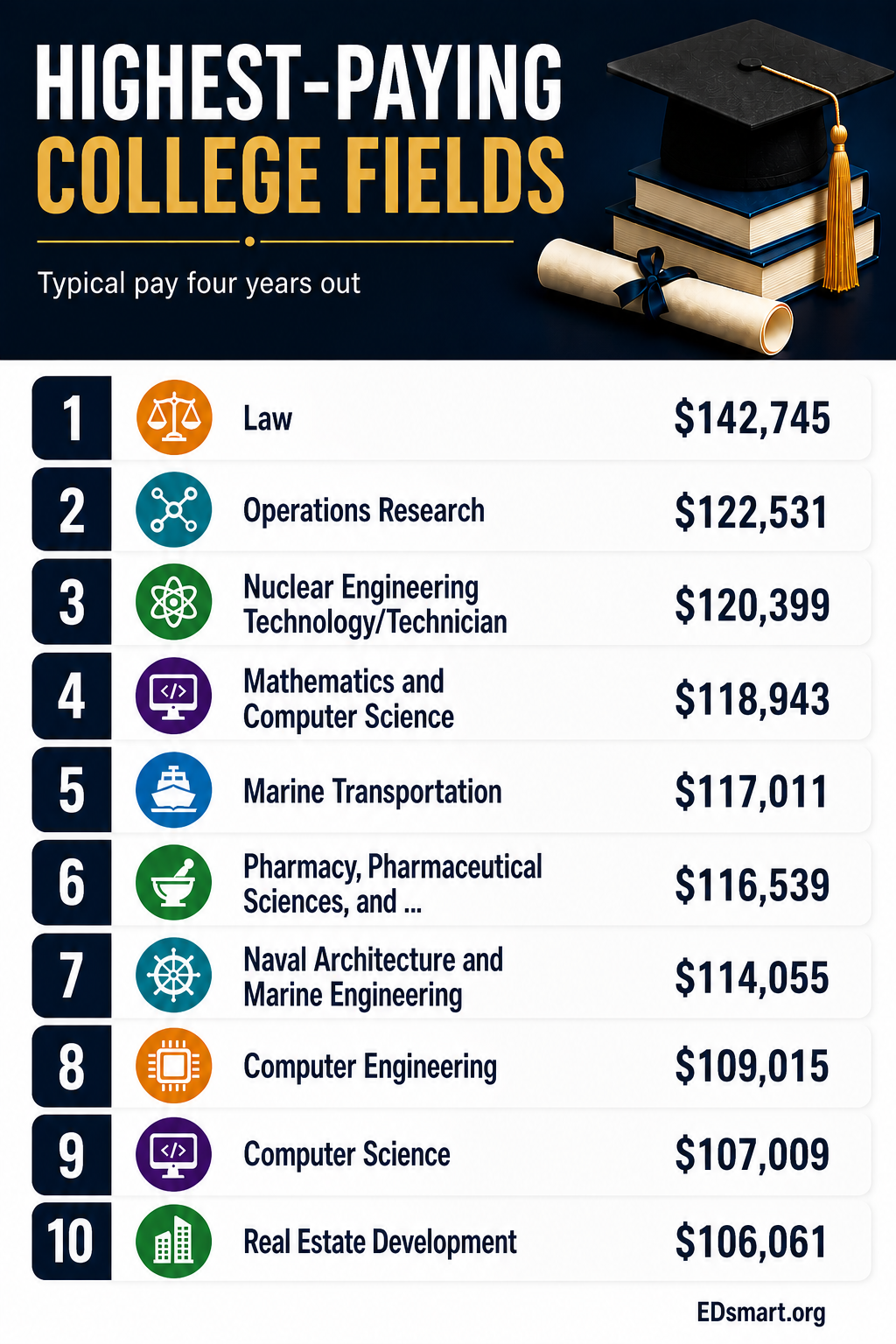
Pay is not the only reason to pick a major, but it is one of the few outcomes you can line up on the same ruler nationwide. The U.S. Department of Education’s College Scorecard publishes median earnings for people who completed a bachelor’s degree, split by broad field of study. This guide shows where paychecks tend to land early and where they tend to land after a few years in the workforce, then lists the same 50 fields in one ranking table (plus a short chart for the top 15) before you dig into outcomes at a specific campus.
Fields are ordered by typical pay about four years after completion. That window is the federal government’s most useful public snapshot for how incomes settle after college. The one-year column uses the pool described in the source note at the end of the page. Some fields still show a dash when coverage is too thin.
All figures are wages only (not stock, bonuses, retirement, or health coverage). Private salary surveys are not mixed in. If you want the government’s own definitions, read how Scorecard measures earnings. EDsmart.org analyzed data gathered by EDsmartData.com; underlying values come from the College Scorecard Field of Study data file (refreshed May 4, 2026). For how EDsmart approaches rankings in general, see our rankings methodology.
What This Page Measures
- Cohort: people who finished a bachelor’s degree, grouped by field of study.
- Primary rank: higher typical pay four years after completion ranks higher.
- Secondary column: one-year typical pay from a count-weighted pool of school-published medians in the same file; a dash when coverage is too thin.
- Privacy: small programs can suppress cells.
When One-Year And Four-Year Pay Point In Different Directions
Scorecard publishes both timelines when it can. They answer different questions. One-year medians lean on first jobs and first cities. Four-year medians reflect moves into management, graduate school, part-time work, or different industries. When the gap is wide, treat it as a signal to read the label, not as a promise about your own arc.
| Field (rank by 4-year pay) | About 1 year out | About 4 years out | What the gap suggests |
|---|---|---|---|
| Computer Science (#9) | $77,385 | $107,009 | Very high early tech hiring in expensive markets can lift year one; year four reflects a wider mix of roles and locations. |
| Mathematics and Computer Science (#4) | $89,651 | $118,943 | Similar story: competitive first offers, then a broader spread of career paths. |
| Real Estate Development (#10) | $49,353 | $106,061 | Lower analyst-style starts, then higher pay as deal responsibility grows for people who stay in the track. |
| Computational Science (#12) | $43,834 | $104,864 | Early roles can look academic or lab-heavy; later medians rise as skills compound in applied settings. |
| Registered Nursing (#48) | $83,188 | $88,910 | Shift work, overtime, and hospital demand can lift early medians in some markets; year four can include different schedules, settings, or hour changes. |
Keep those column differences in mind as you scan the full ranking. A short FAQ at the end answers the most common one-year versus four-year questions in plain language after you have seen the full table.
Three Labels That Trip People Up
Law (#1 on four-year pay). In Scorecard, this is mostly undergraduate legal studies and related programs, not a J.D. If you want to practice as an attorney, you still need the graduate pathway your state requires. One-year pay is not published for this bucket.
Pharmacy, Pharmaceutical Sciences, and Administration (#6). The label bundles bachelor’s-level science and industry-facing tracks. Many clinical pharmacist roles expect doctoral training, so read job postings alongside the median.
Petroleum engineering (#13). It is still a strong four-year wage in these data, but it is not automatically #1 on this measure anymore. Commodity cycles and where you hire still dominate any one graduate’s story.
Related Programs That Might Interest You
Learn about start dates, transferring credits, availability of financial aid, and more by contacting the universities below.Chart: Top 15 Fields On Four-Year Pay
Bars use the same rule as the ranking table below: longer bars mean higher national median pay four years after a bachelor’s degree. If you already opened the small top-ten graphic near the intro, this chart adds ranks eleven through fifteen on the same four-year measure.
All 50 Fields In Rank Order
This single table is the complete ranking. Search in your browser if you need one label fast.
| Rank | Field of study | About 1 year out | About 4 years out |
|---|---|---|---|
| 1 | Law | — | $142,745 |
| 2 | Operations Research | $88,685 | $122,531 |
| 3 | Nuclear Engineering Technology/Technician | $101,386 | $120,399 |
| 4 | Mathematics and Computer Science | $89,651 | $118,943 |
| 5 | Marine Transportation | $84,187 | $117,011 |
| 6 | Pharmacy, Pharmaceutical Sciences, and Administration | $49,444 | $116,539 |
| 7 | Naval Architecture and Marine Engineering | $100,024 | $114,055 |
| 8 | Computer Engineering | $81,123 | $109,015 |
| 9 | Computer Science | $77,385 | $107,009 |
| 10 | Real Estate Development | $49,353 | $106,061 |
| 11 | Systems Engineering | $81,785 | $105,185 |
| 12 | Computational Science | $43,834 | $104,864 |
| 13 | Petroleum Engineering | $68,913 | $104,823 |
| 14 | Paper Science and Engineering | $86,401 | $102,121 |
| 15 | Mechatronics, Robotics, and Automation Engineering | $80,491 | $101,649 |
| 16 | Mining and Mineral Engineering | $85,897 | $101,390 |
| 17 | Electromechanical Engineering | $84,375 | $101,277 |
| 18 | Military Science and Operational Studies | $55,351 | $101,117 |
| 19 | Electrical, Electronics, and Communications Engineering | $77,971 | $100,647 |
| 20 | Nuclear Engineering | $74,540 | $99,297 |
| 21 | Industrial Engineering | $76,390 | $98,442 |
| 22 | Aerospace, Aeronautical, and Astronautical/Space Engineering | $75,036 | $98,207 |
| 23 | Chemical Engineering | $75,102 | $98,158 |
| 24 | Construction Engineering | $77,845 | $97,303 |
| 25 | Science Technologies/Technicians, General | $71,144 | $96,876 |
| 26 | Construction Management | $72,779 | $95,124 |
| 27 | Biochemical Engineering | $70,668 | $94,996 |
| 28 | Materials Sciences | $72,216 | $94,684 |
| 29 | Engineering, Other | $74,204 | $93,989 |
| 30 | Construction Engineering Technology/Technician | $74,199 | $93,843 |
| 31 | Engineering Science | $73,378 | $93,782 |
| 32 | Construction Trades, Other | — | $93,761 |
| 33 | Biomedical/Medical Engineering | $66,075 | $93,451 |
| 34 | Engineering Mechanics | $72,612 | $93,437 |
| 35 | Polymer/Plastics Engineering | $68,438 | $92,919 |
| 36 | Metallurgical Engineering | $78,984 | $92,722 |
| 37 | Statistics | $59,718 | $92,425 |
| 38 | Computer and Information Sciences, General | $67,315 | $92,374 |
| 39 | Mechanical Engineering | $70,763 | $92,135 |
| 40 | Applied Mathematics | $61,741 | $91,532 |
| 41 | Materials Engineering | $74,496 | $91,449 |
| 42 | Building/Construction Finishing, Management, and Inspection | $71,202 | $90,924 |
| 43 | Engineering-Related Fields | $71,117 | $89,619 |
| 44 | Architectural Engineering | $76,272 | $89,406 |
| 45 | Engineering, General | $68,331 | $89,359 |
| 46 | Ocean Engineering | $70,939 | $89,337 |
| 47 | Engineering Physics | $58,025 | $89,154 |
| 48 | Registered Nursing, Nursing Administration, Nursing Research and Clinical Nursing | $83,188 | $88,910 |
| 49 | Mathematics and Statistics, Other | $59,063 | $88,839 |
| 50 | Insurance | $64,131 | $88,472 |
Related Programs That Might Interest You
Learn about start dates, transferring credits, availability of financial aid, and more by contacting the universities below.Source: U.S. Department of Education College Scorecard Field of Study file. Four-year typical pay uses the national median published for each bachelor’s field. The one-year column is a count-weighted median of institution-level medians where the file reports them, because the extract does not ship a matching national one-year cell for every field.