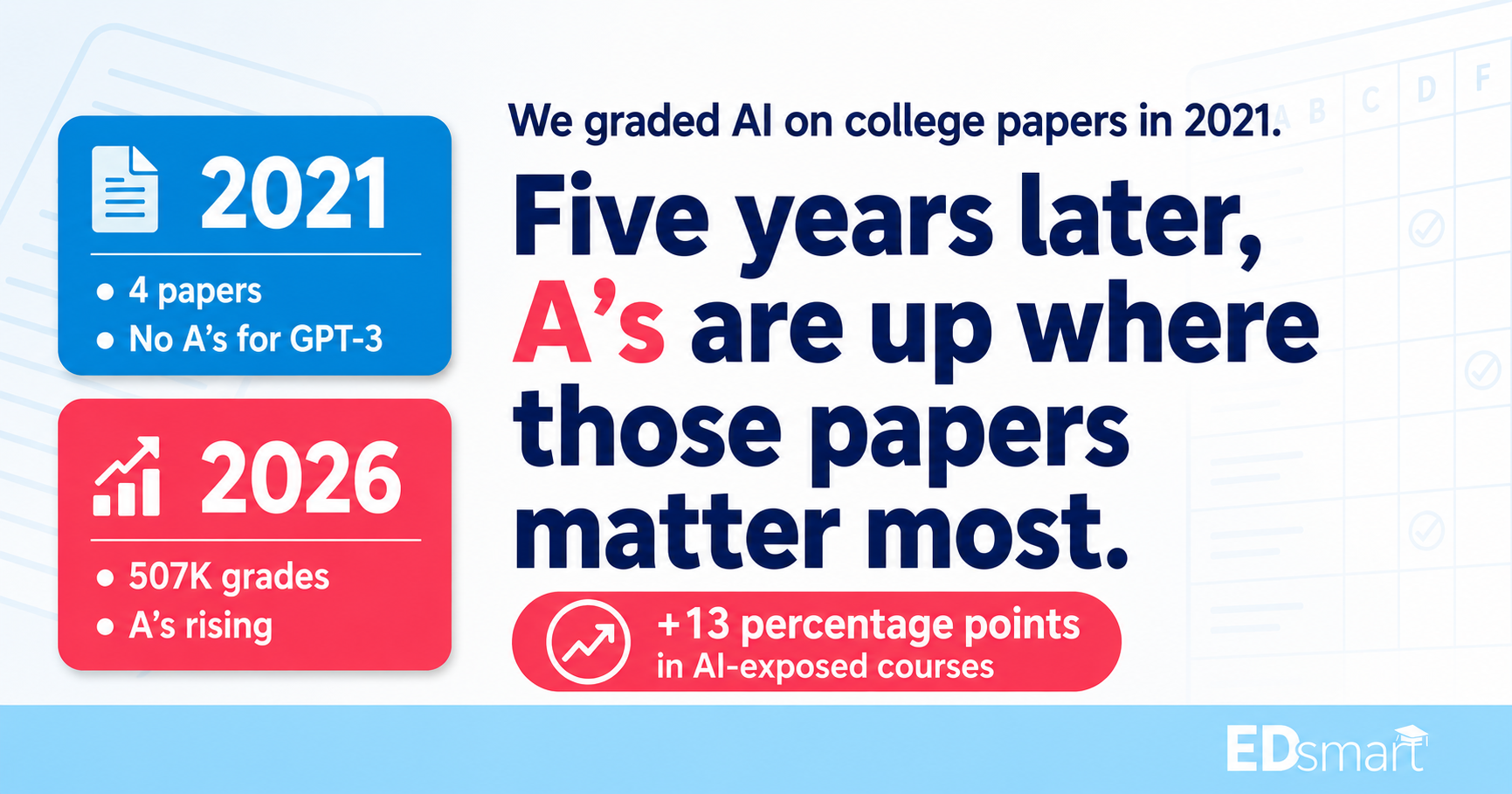
We graded AI on college papers in 2021. In 2026, A’s are up where they matter most.
From “C’s get degrees” to grade-book inflation: what changed after ChatGPT, and what our 2021 study foreshadowed.
Before ChatGPT existed, professors on our sister site Best Universities (previously EduRef.net) blind-graded papers from GPT-3 and undergraduate-level writers. The AI mostly earned B’s and C’s and failed creative writing. Today, economist Igor Chirikov’s analysis of more than 500,000 grades, behind Wall Street Journal coverage, shows A’s rising fastest in courses built around the same kinds of writing and coding tasks. This piece connects our 2021 data to student surveys, headline debates, and real transcript trends.
How to use this article
What it’s for: Separating three threads that often get tangled: (1) how well AI performs on graded assignments in experiments, (2) whether students believe AI helps their grades, and (3) whether actual transcript grades have shifted since ChatGPT. Our 2021 classroom-style test is the through-line; newer studies and surveys sit beside it, not in place of it.
- Our 2021 professor-graded study → What grades could AI get in 2021?
- Headlines vs. skepticism (2023) → “AI passed Harvard” and the pushback
- Student surveys (2024) → Pearson: students say AI helps grades
- Grade-book research (2025–2026) → UC Berkeley working paper & WSJ coverage
- What colleges are trying → Assessment and policy responses
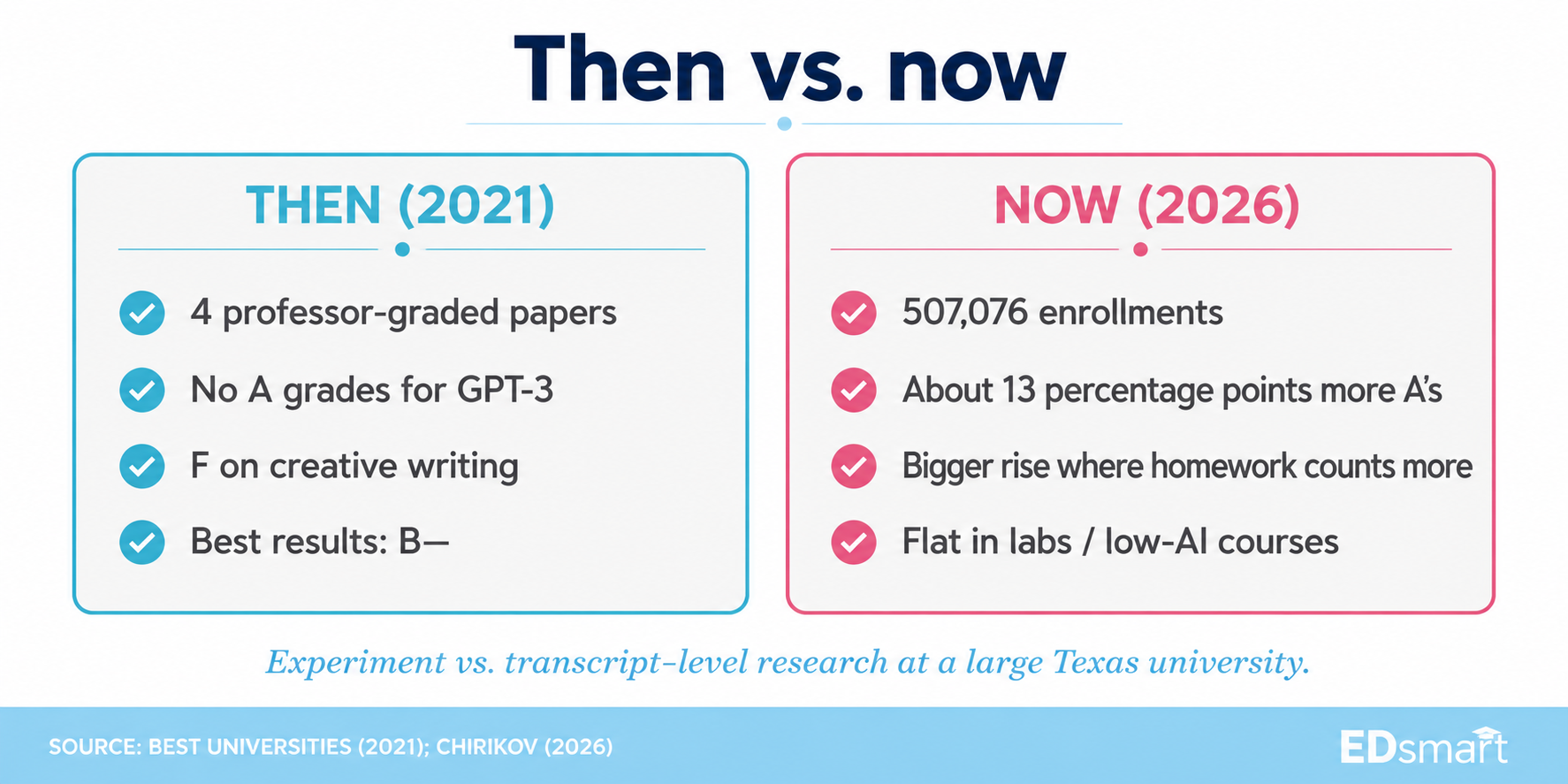
Start here: We graded AI on college papers in 2021; five years later, A’s are up where those papers matter most. In that study, professors graded anonymous submissions from GPT-3 and undergraduate-level writers across four subjects. The AI passed most assignments but earned a C on average and an F on creative writing.
After ChatGPT’s 2022 launch, experiments and media stories swung toward “AI can pass elite courses,” while faculty critics argued those demos ignored attendance, revision, citations, and in-class work.
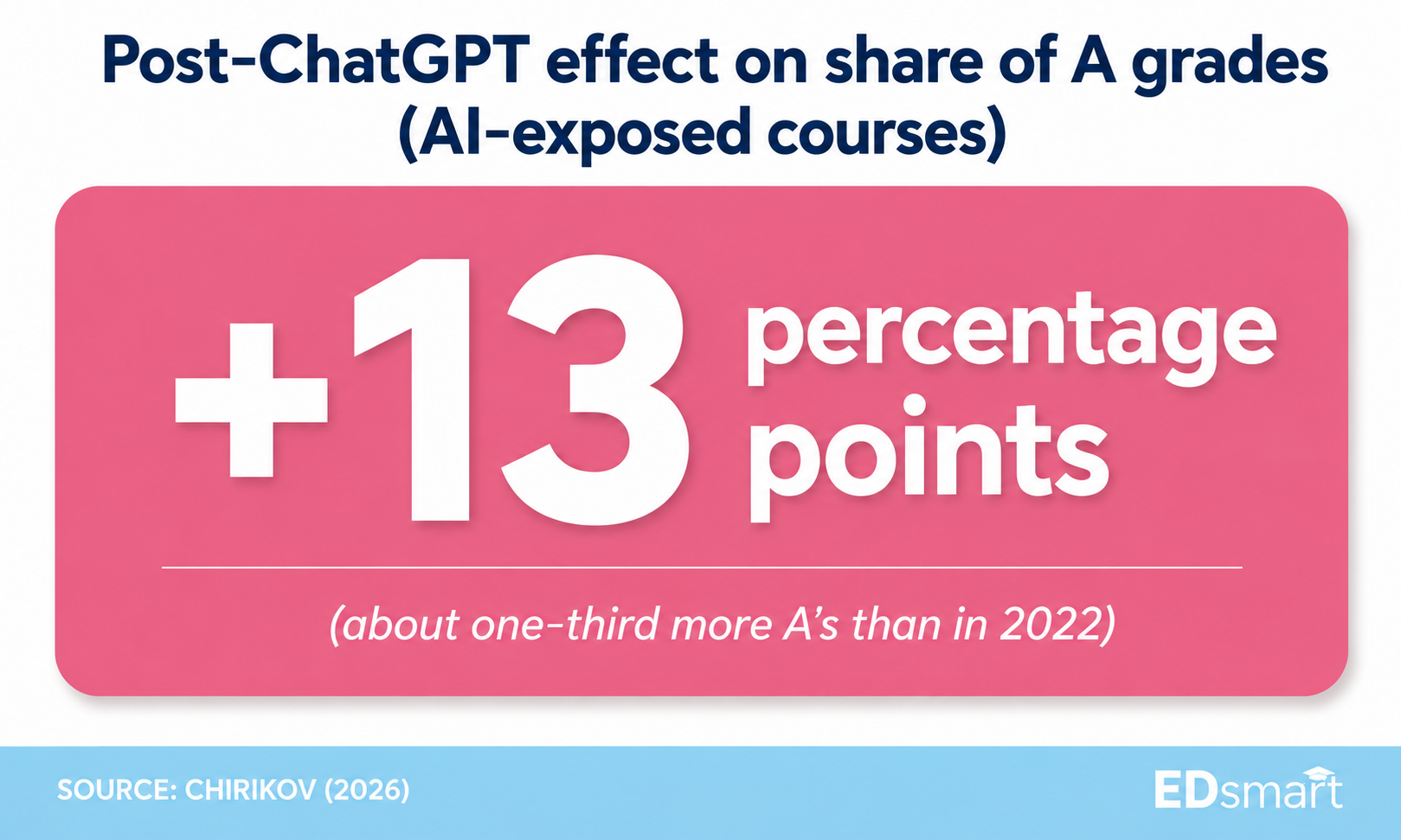
By 2024, a Pearson survey found 51% of U.S. college students said generative AI had helped them get better grades. In 2026, economist Igor Chirikov’s analysis of more than 500,000 grades at a large Texas university found the share of A’s rose about 13 percentage points in “AI-exposed” courses. That means if about 44 out of 100 grades were A’s before, the rate moved toward 57 out of 100, a real 13-point jump on the grading scale, not the same as “13% higher.” The increase was about one-third more A’s than in 2022, especially where homework counted for more of the final grade. Grades in low-exposure courses (e.g., labs, sculpture) stayed flat.
Employers, meanwhile, are raising GPA bars on job platforms. Grades and AI are no longer a hypothetical; they’re showing up on transcripts and in hiring filters.
What’s in this article
5 things to know
- 2021 (pre-ChatGPT): GPT-3 earned mostly B’s and C’s from professors and failed a creative-writing narrative; our 2021 study on Best Universities.
- 2023: High-profile “GPT-4 passed freshman year at Harvard” claims drew sharp faculty rebuttals: edited outputs, no citations, and no participation in real course structures.
- 2024: Pearson reported 51% of students said gen AI helped them get better grades (up from 47% in fall 2023).
- 2026: Chirikov’s working paper links post-ChatGPT A-grade jumps to courses heavy on writing/coding tasks and homework weight, consistent with AI-assisted submissions, not uniform learning gains.
- Takeaway: We graded AI on college papers in 2021; five years later, A’s are up where those assignments matter most on syllabi, and what those grades mean for learning and hiring is murkier than ever.
Why this story is everywhere in May 2026
The Wall Street Journal reported that A grades have surged since ChatGPT arrived, spotlighting economist Igor Chirikov’s unpublished analysis of hundreds of thousands of grades at a selective Texas university. Coverage quickly spread to Axios, Futurism, and others, often with the same punch line: a “C student” can look like an “A student” when coursework leans on take-home writing or code.
Grade inflation long predates AI. What’s new is a technology that can complete the tasks those grades were meant to measure, at scale, outside the classroom, and with weak detection. That’s why a 2021 classroom-style benchmark still matters: it shows where AI stood before the tool most students actually use existed.
2021: What grades could AI get in college?
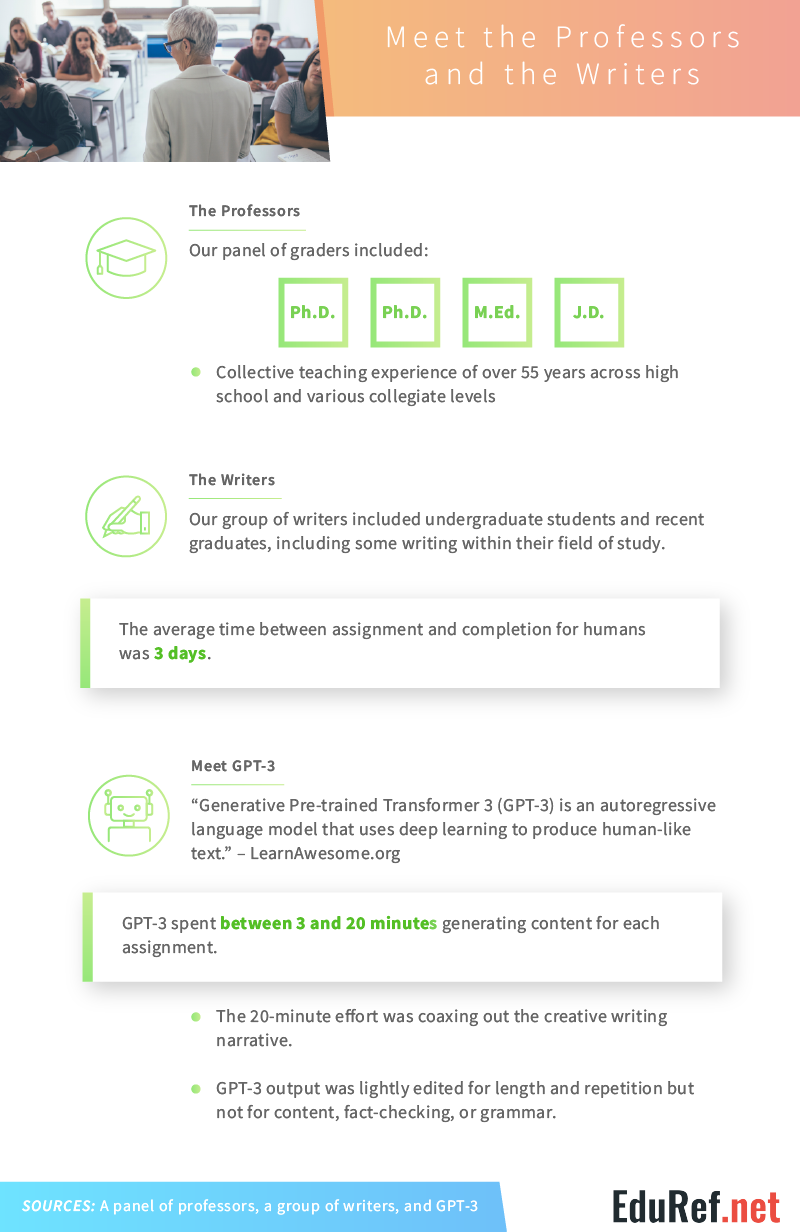
In 2021, Best Universities (a sister site in our network) ran one of the first professor-graded comparisons of AI versus human undergraduates. Researchers hired a panel of four instructors (two Ph.D.s, one M.Ed., one J.D., with more than 55 combined years of teaching) to write prompts, grade blind submissions, and comment on the “writers.”
On one side: about a dozen freelance writers who were current undergraduates or recent grads. On the other: GPT-3, prompted with the same assignments. GPT-3’s output was lightly trimmed for length and repetition only, not fact-checked, grammar-fixed, or rewritten for content.
Grades by assignment (2021)
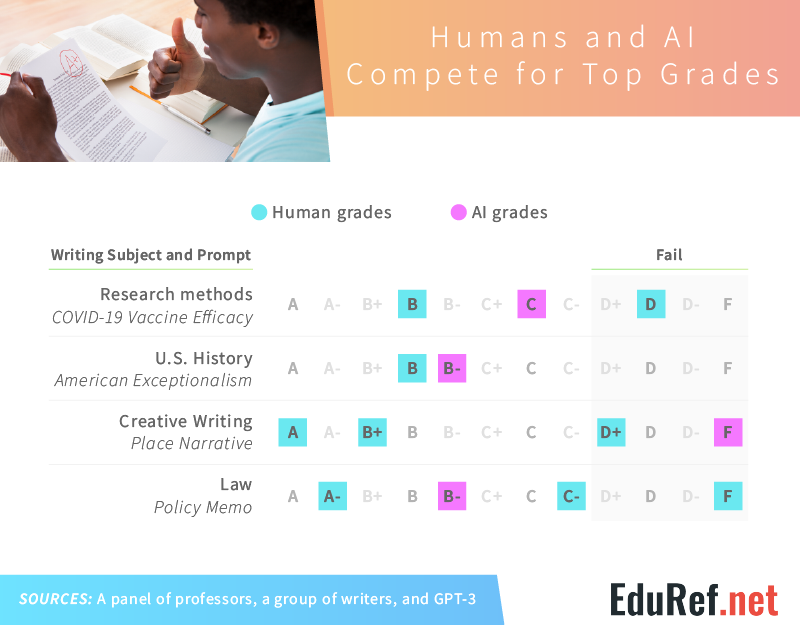
| Subject / assignment type | Human writers | GPT-3 |
|---|---|---|
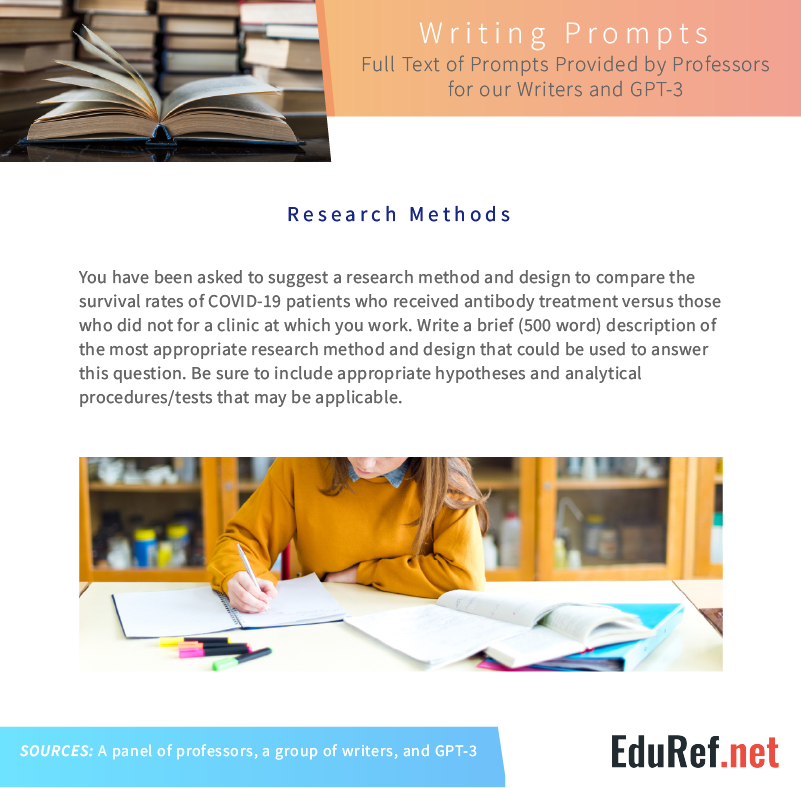
| Research methods (COVID vaccine efficacy) | B and D | C |
| U.S. history (American exceptionalism) | B and C+ | B− |
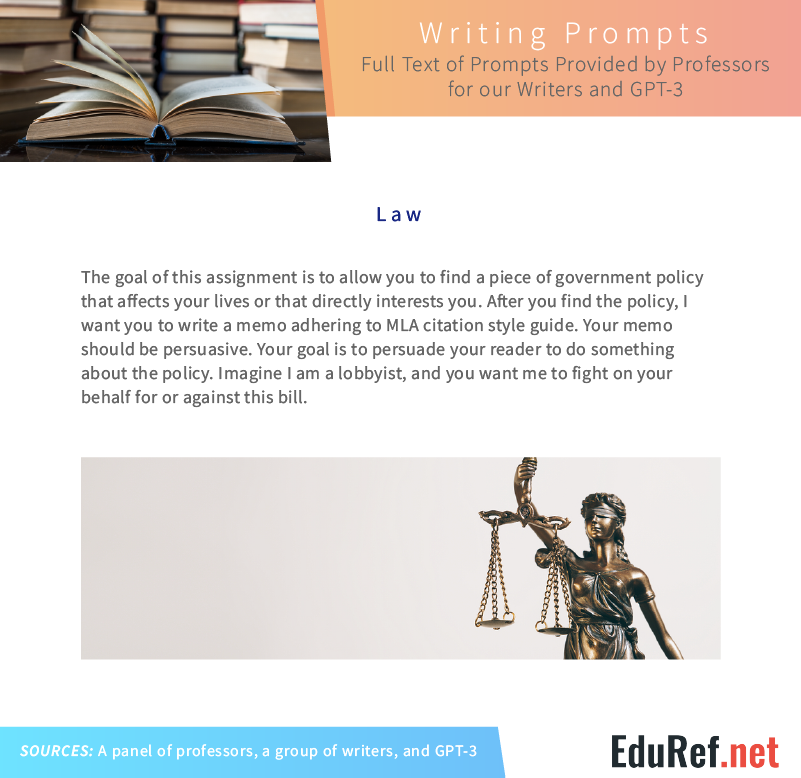
| Law (policy memo) | One student above B− | B− (passed) |
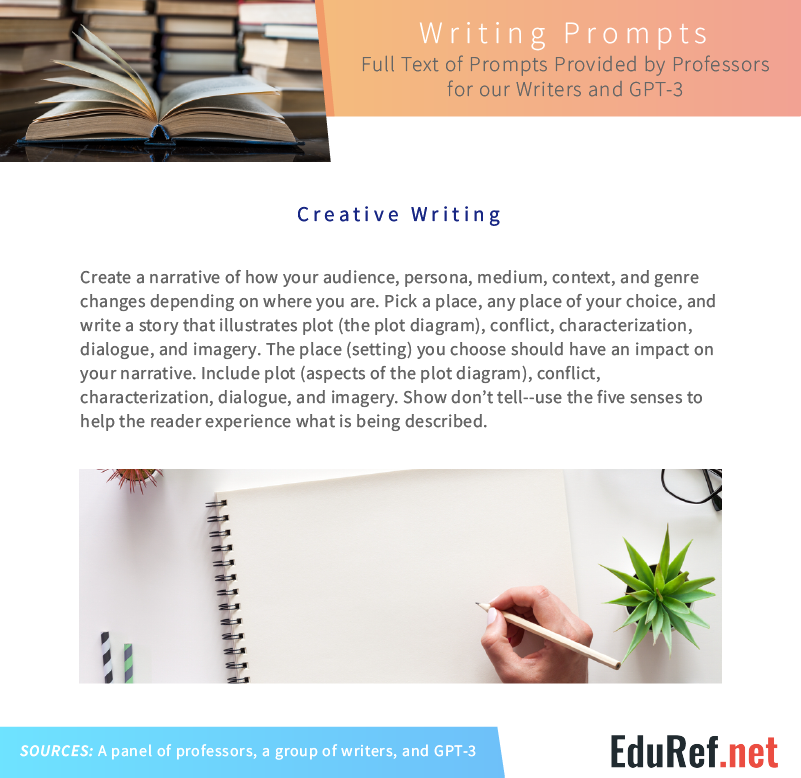
| Creative writing (place narrative) | A, B+, D+ | F |
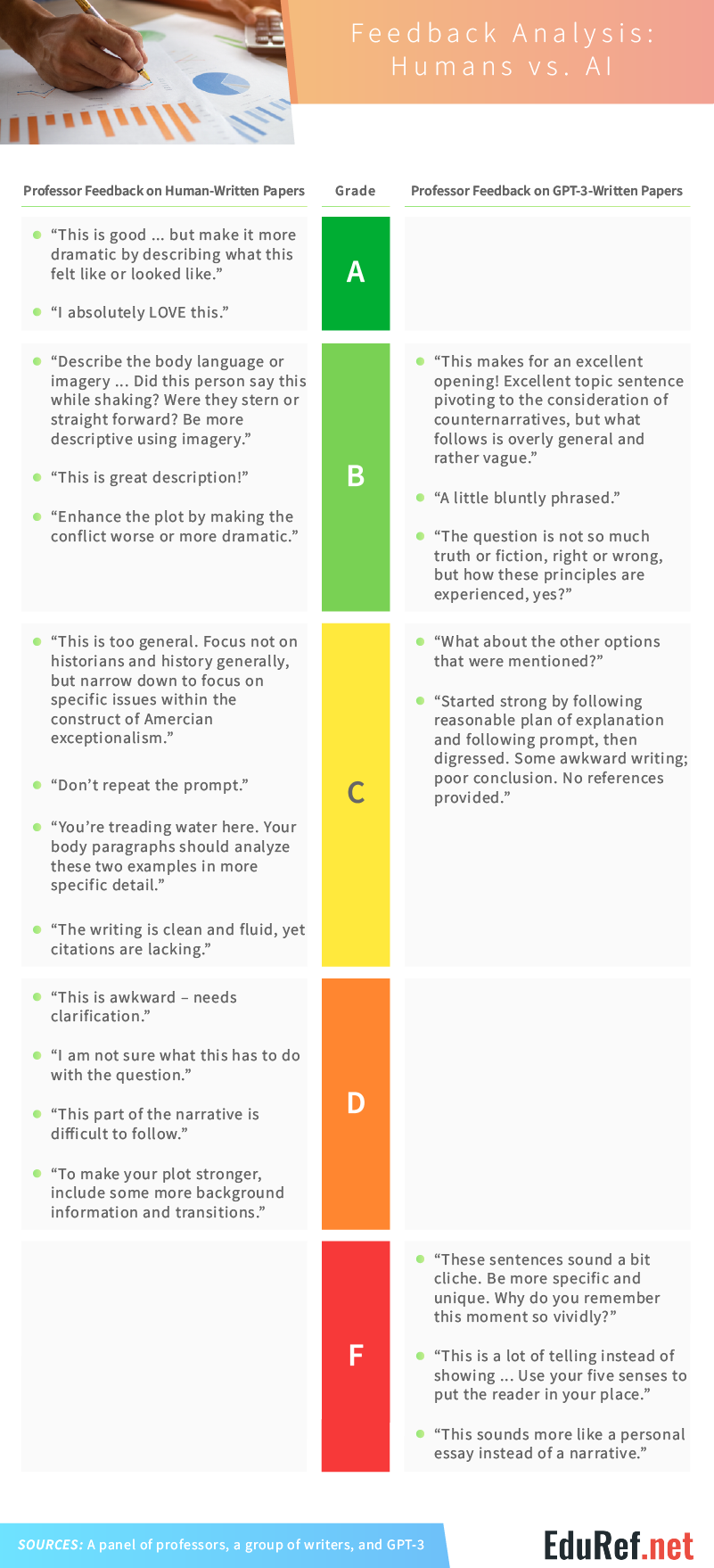
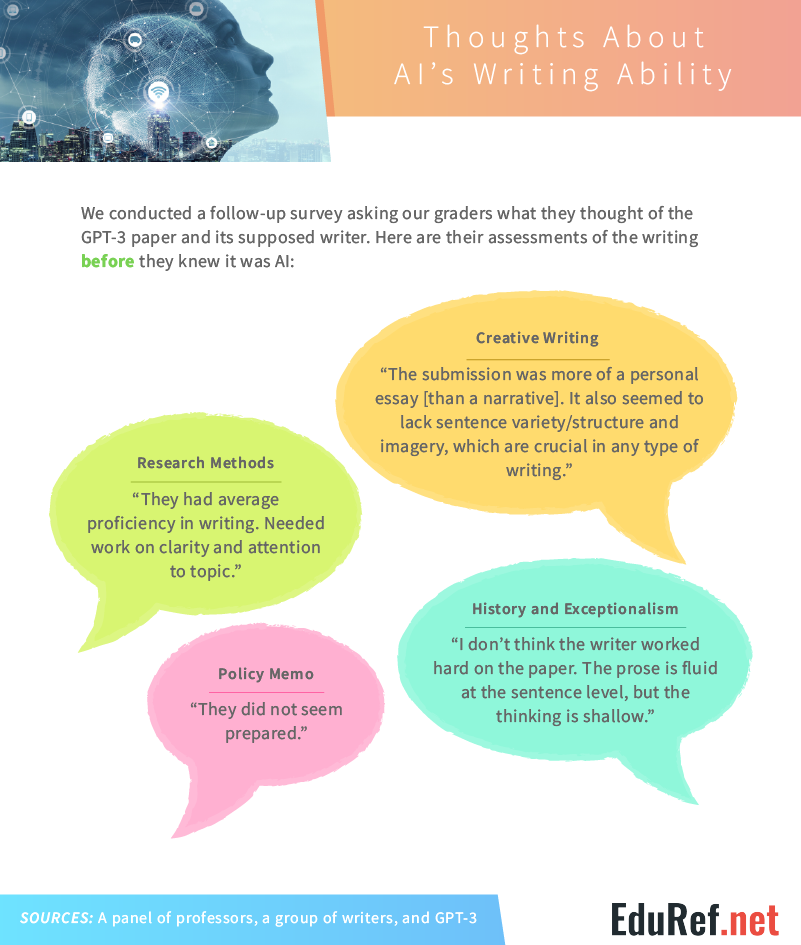
Bottom line in 2021: “C’s get degrees” fit GPT-3 more than straight A’s. The model could pass analytical and policy-style papers but could not craft a narrative that satisfied a creative-writing rubric (sensory detail, showing vs. telling, sentence variety). Professors’ comments on AI papers often praised openings yet called the work vague, blunt, or citation-thin, even when the letter grade was passing.
Two details still resonate today:
- Speed vs. depth: GPT-3 finished each paper in under 20 minutes; humans averaged about three days. Speed did not buy top marks on the hardest genre.
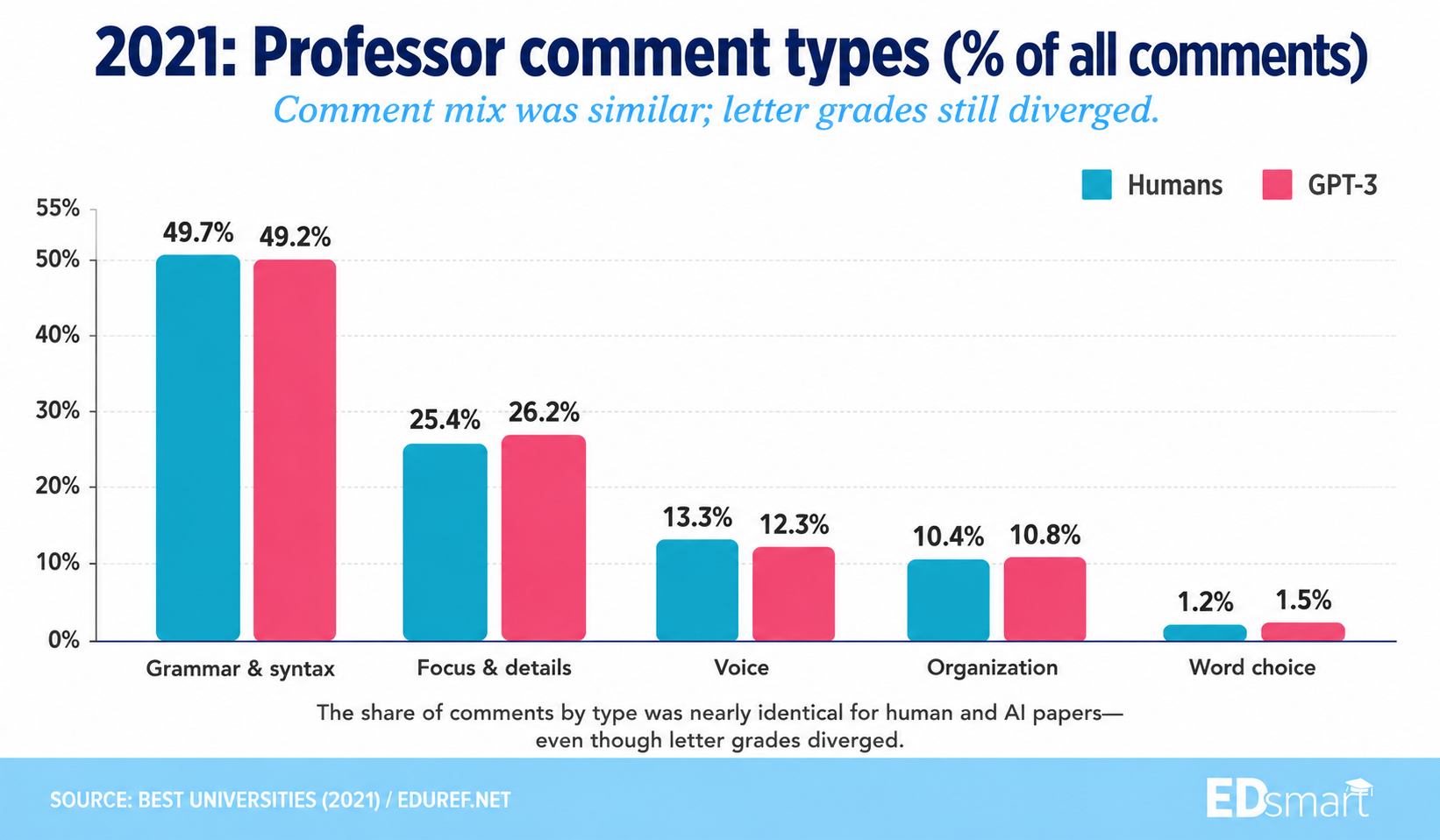
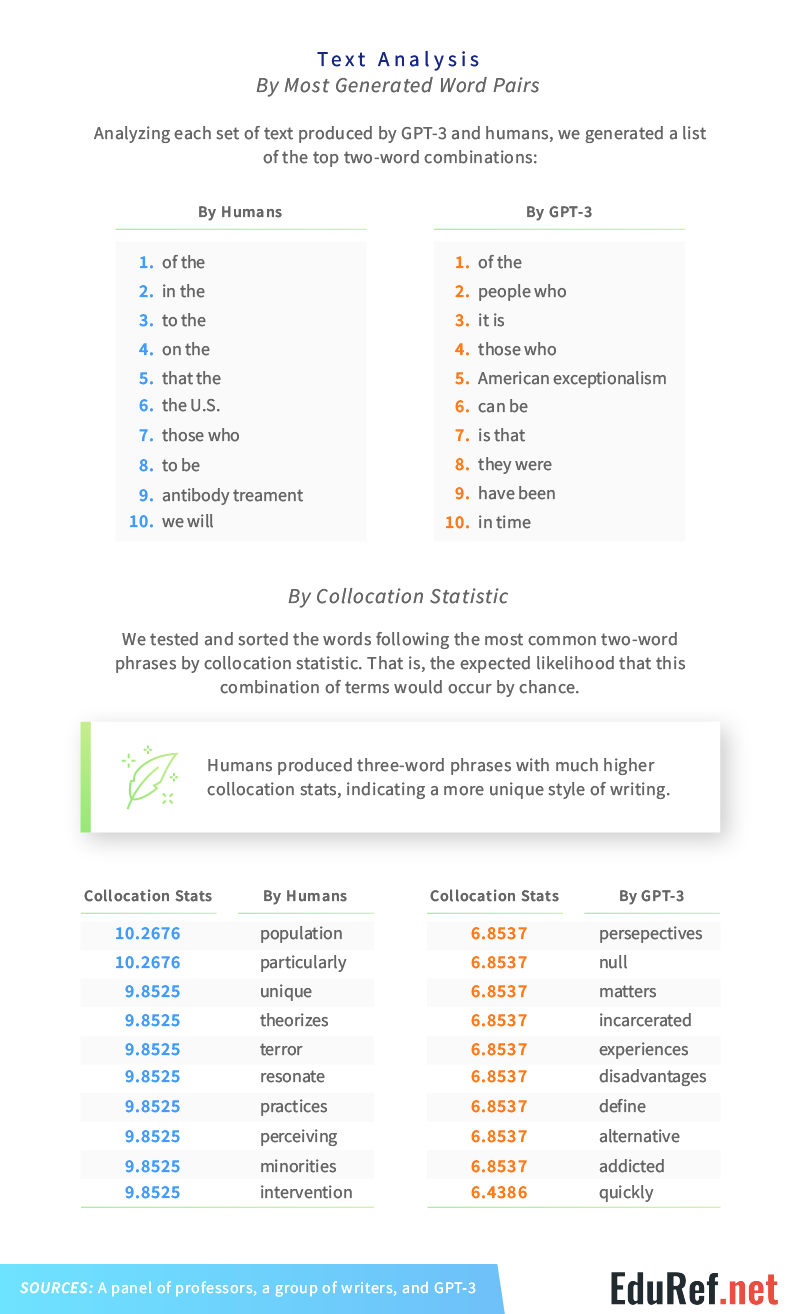
- Similar comment themes: Roughly half of feedback on both human and AI papers focused on grammar and syntax; about a quarter on focus and detail, but humans’ word choices were more distinctive (higher collocation scores), a hint that surface polish and real student voice diverged even then.
The four professor-written prompts
Each assignment was a real college-style task, not a trivia quiz. Below are the prompts exactly as professors supplied them to writers and GPT-3.

What professors said about the writing
Graphics from the 2021 Best Universities / EduRef.net study. Republished by EDsmart with attribution; methodology in Methodology note below.
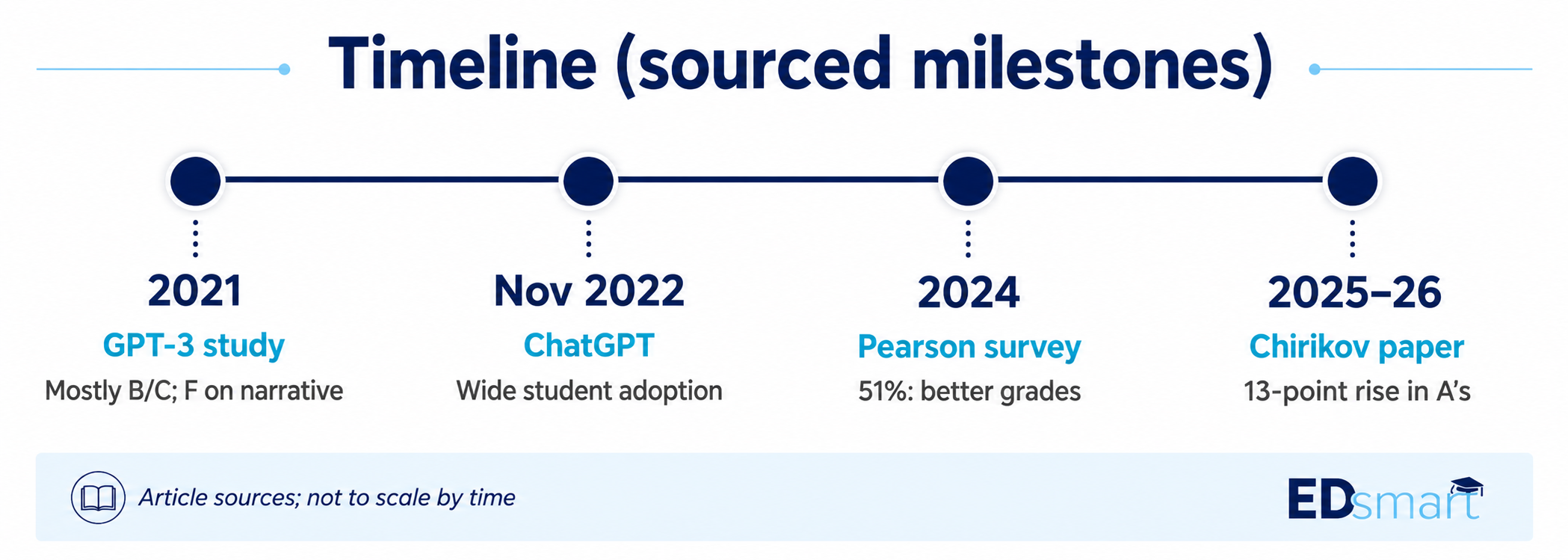
Timeline at a glance
| When | What happened | Grade / signal takeaway |
|---|---|---|
| 2021 | Best Universities professor-graded GPT-3 vs. students | Mostly B/C; F on creative narrative |
| Nov 2022 | ChatGPT public release | Tool students actually adopt at scale |
| 2023 | “GPT-4 passes Harvard freshman year”; faculty pushback; MIT students debunk “AI aces MIT” | Headline grades on edited, decontextualized essays |
| 2024 | Pearson / Morning Consult survey (n≈800 U.S. college students) | 51% say gen AI helped better grades (up from 47% in fall 2023) |
| 2025 | Hausman et al. (Israeli university); CEPR summary | Grades up in AI-compatible courses; compressed distribution; weaker rank signal |
| May 2026 | Chirikov working paper; WSJ, Axios | About 13 percentage points more A’s in AI-exposed courses after ChatGPT |
2023: “AI passed Harvard” and the pushback
After ChatGPT, media and vendor benchmarks flipped the 2021 story. The Chronicle of Higher Education published undergraduate Maya Bodnick’s account that GPT-4 could “pass” a freshman year at Harvard on a handful of graded essays (mostly A’s and B’s). Faculty critics, including Steven D. Krause at Eastern Michigan University, argued the demo was not a real semester: outputs were stitched together, citations ignored, prompts stripped of course context, and participation absent (Krause, 2023).
Earlier that summer, The Chronicle also reported MIT students challenging claims that AI could “ace” MIT coursework when exam design made perfect scores impossible or questions under-specified. The pattern: isolated, optimized submissions versus how colleges actually award credit (attendance, drafts, exams, labs).
That gap matters for interpreting today’s grade inflation: if 2023 headlines measured “best possible essay with human editing,” 2026 transcript data measure what happens when millions of students have a free co-author on homework.
2024: Students say AI is helping them get better grades
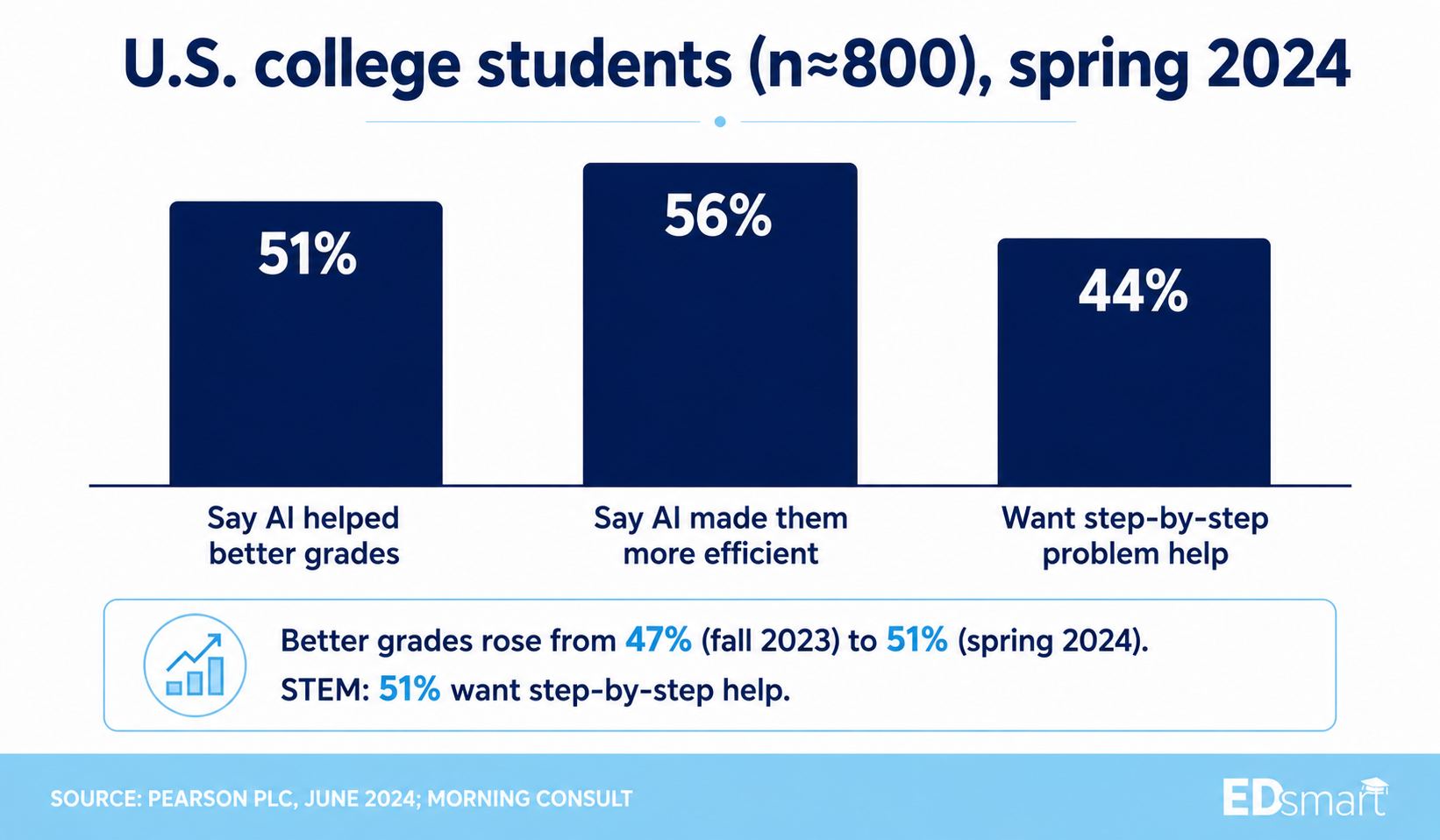
Pearson’s End of Semester AI Report (June 2024, with Morning Consult) surveyed about 800 nationally representative U.S. college students. Findings included:
- 51% said generative AI had helped them get better grades in spring 2024, up from 47% in fall 2023.
- 56% said AI made them more efficient, up from 49% in fall 2023.
- 44% wanted tools that walk them through problems; for STEM majors, 51%.
Pearson framed embedded study tools (in Mastering and eTextbooks) as deepening engagement: students who used AI tools nearly doubled eTextbook sessions, with heavy use between 9 p.m. and 11 p.m. That’s a different claim than “higher GPA with no more learning”: vendor-supported AI tied to content vs. open-ended chat on take-home essays.
Our 2021 study measured instructor grades on AI-authored papers; Pearson measured student perception. Both can be true: AI may still struggle on some in-class genres while students feel or see homework grades rise when they use chat tools.
2025–2026: Grade books, not just paper demos
By 2025–2026, researchers moved from grading one-off essays to comparing distributions across thousands of enrollments before and after ChatGPT.
UC Berkeley: AI-exposed courses and A’s (Chirikov, 2026)
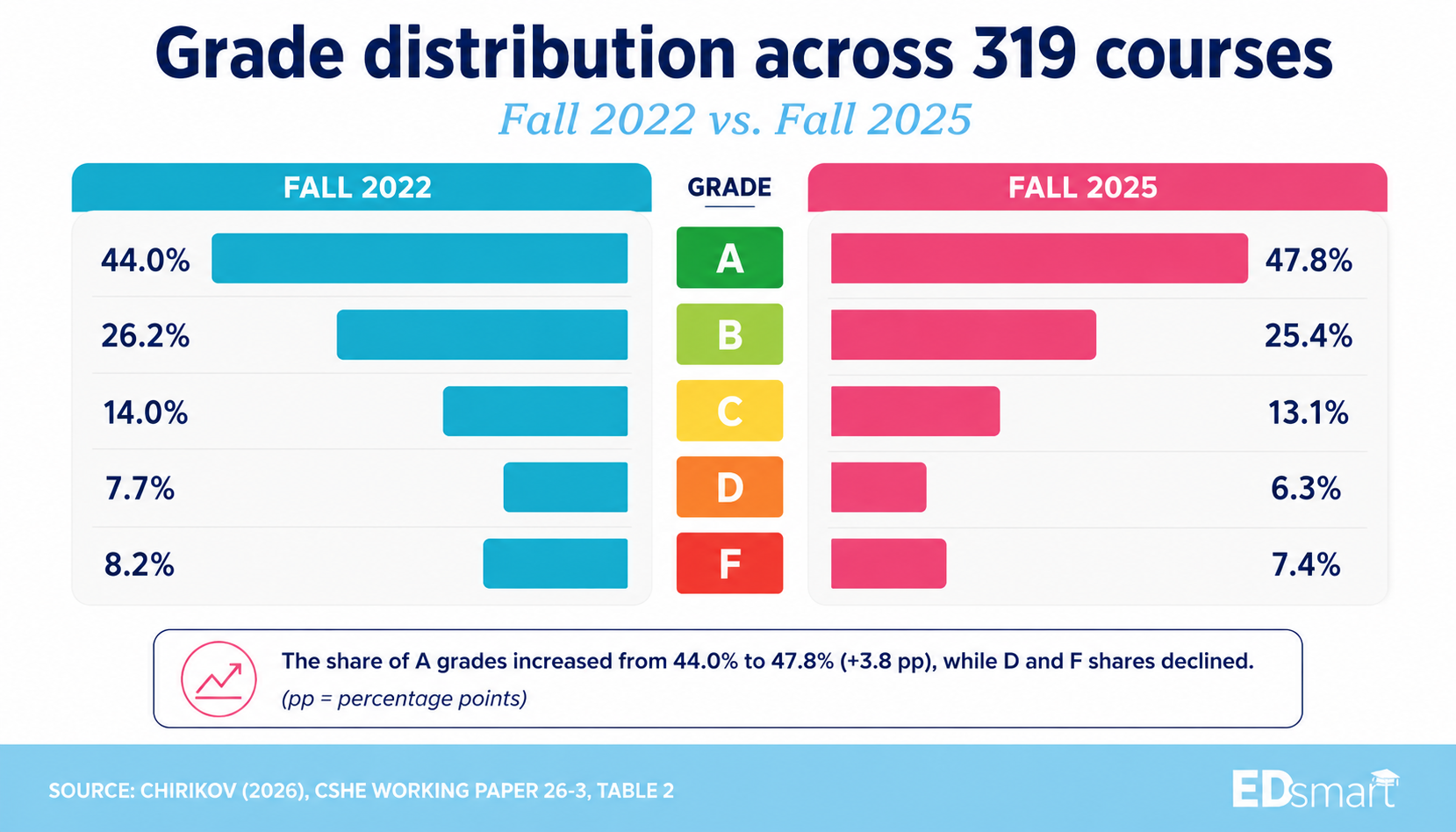
Igor Chirikov (UC Berkeley Center for Studies in Higher Education) analyzes 507,076 student-course enrollments across 319 courses (84 departments) at a large selective public university in Texas, Fall 2018–Fall 2025. “AI exposure” comes from each course’s Fall 2022 syllabus (published before ChatGPT): the share of required tasks involving writing and coding, where generative AI is strongest.
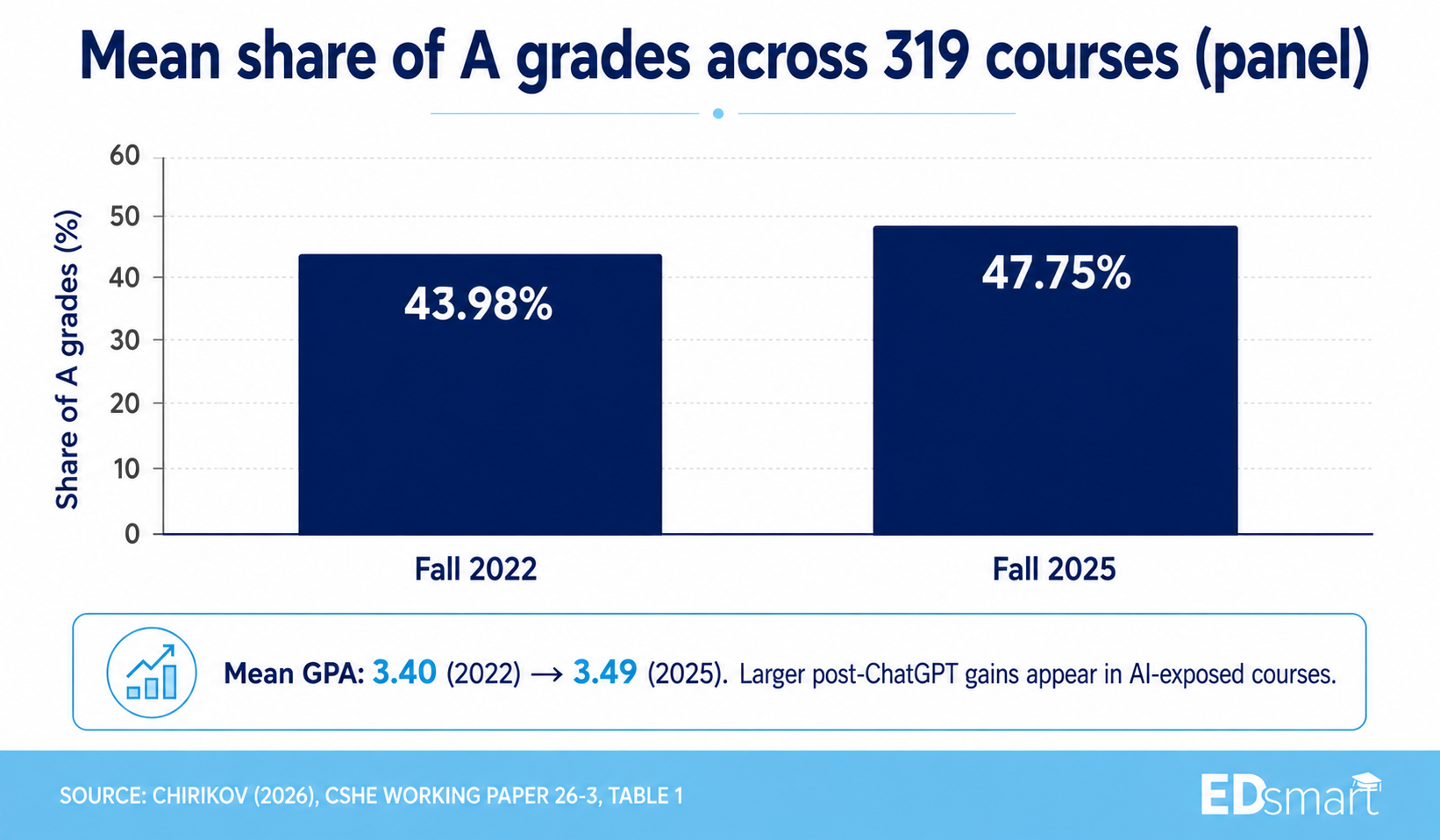
Main results (difference-in-differences, post–Nov 2022):
- Share of A grades up about 13 percentage points in high-exposure courses, about one-third more A’s than in 2022.
- GPA up about 0.12 points, with compression (less spread) at the top of the distribution.
- In low-exposure courses (e.g., oral presentations as placebo; sculpture, labs), no comparable jump.
- Triple-difference: Effects are larger where homework counts for more of the final grade, hard to explain by broad learning gains or student sorting alone; more consistent with AI substituting for unsupervised work (Chirikov, 2026 working paper).
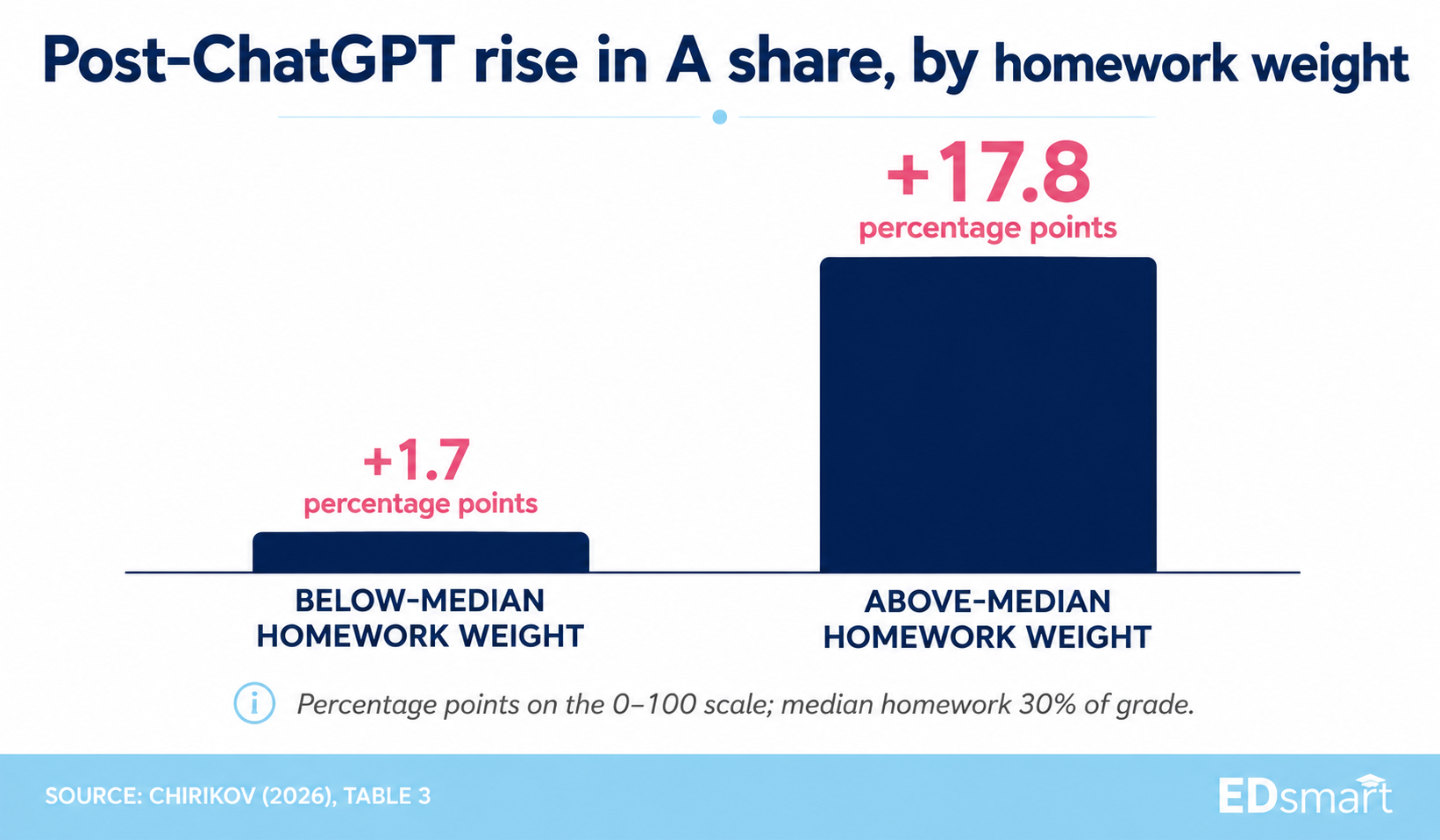
Chirikov told Axios the pattern is not “A− becomes A” but weaker students moving up the scale; e.g., “a C student who is now an A student” in exposed courses. He argues AI exacerbates existing inflation trends rather than inventing them, and calls for AI-integrated assignments with documented tool use, not only detection arms races.
Israeli university study (Hausman, Rigbi, Weisburd)
A separate line of work, summarized on CEPR VoxEU, tracks roughly 36,000 students in 6,000 courses at an Israeli university (2018–2024). Courses heavy on take-home essays/projects (“AI-compatible”) vs. supervised exams show:
- Average grades up 1–1.5 points on a 0–100 scale in compatible courses after ChatGPT.
- Largest gains for lower-performing students; failure rates down; fewer very low passes but also compressed tails.
- Students gain on later AI-compatible work after early exposure (AI-specific skill) but do not improve on harder exam-based follow-ups, suggesting substitution away from fundamentals.
- Rank predictability across course types weakens: exam performance tells you less about take-home performance post-ChatGPT.
Together, Chirikov and Hausman et al. support a shared story: grades up, signal down, skills ambiguous, especially where assessment looks like the 2021 paper tasks (writing, take-home analysis) rather than supervised exams.
Grades vs. learning
Commentators increasingly separate performance on graded work from learning. USC professor Erika Patall, writing in EdSource, argues that when grades are the main currency, using AI to perform better while learning less is rational, and that AI removes the “productive friction” novices need. That aligns with early experimental work cited in policy circles on AI undermining skill acquisition when used to bypass struggle.
Our 2021 finding: GPT-3 passed policy and history papers but failed narrative craft, shows rubrics already distinguished “acceptable prose” from “demonstrated human skill.” Post-2022 models narrowed that gap on many take-home genres faster than creative, oral, or lab-based assessment evolved.
Employers and the GPA signal
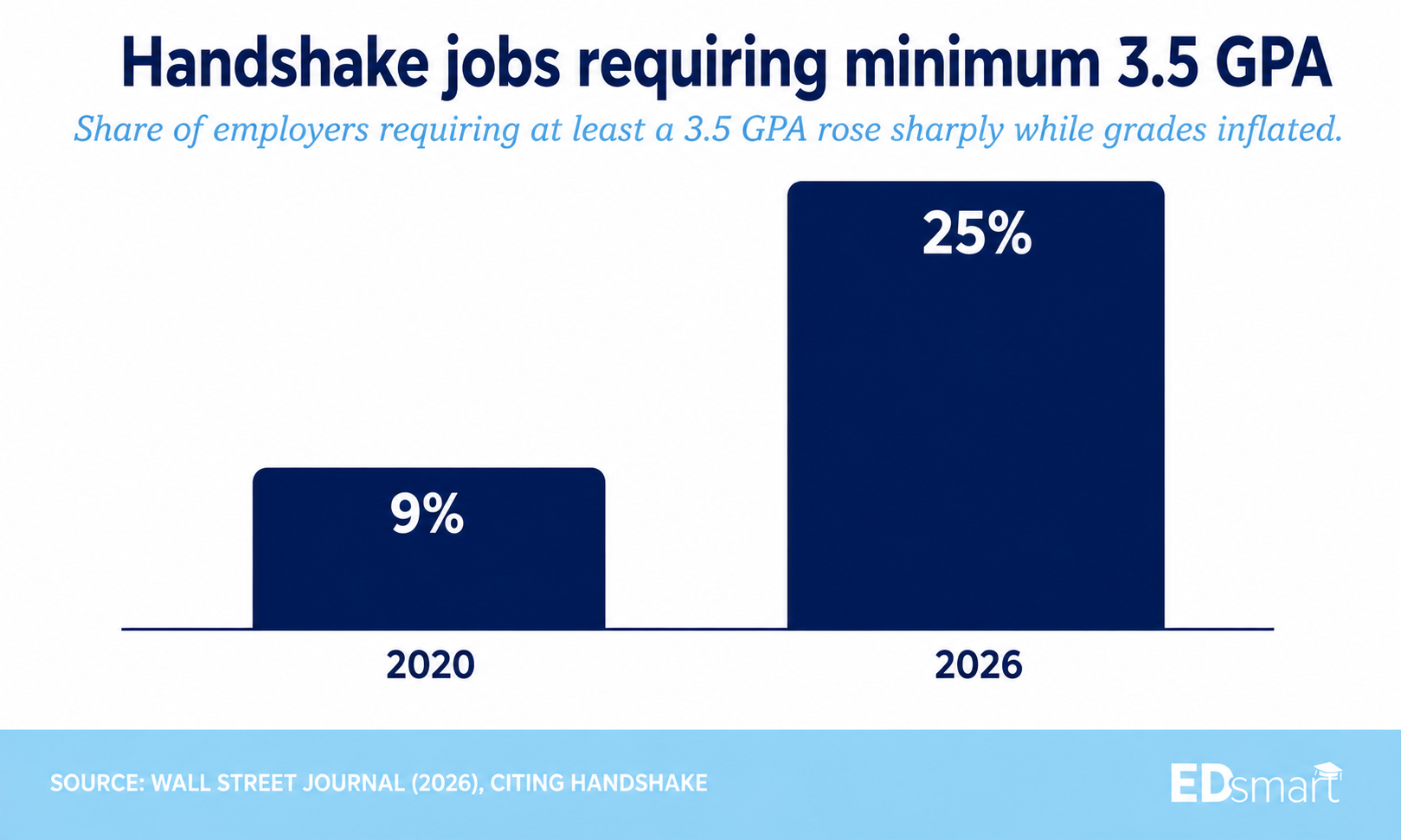
If transcripts inflate in AI-exposed courses, employers may discount GPA. Reporting tied to the WSJ story notes that on Handshake, the share of employers requiring a minimum 3.5 GPA rose to nearly 25% in 2026 from about 9% in 2020, raising the bar just as more students clear it with help on homework. Harvard faculty have discussed capping A’s (e.g., 20% of class) amid reports that roughly 60% of grades were A in 2024–25. Princeton moved toward more supervised exams. The policy fight is as much about what grades certify as about catching cheaters.
What campuses are doing
- Shift assessment toward supervised work: In-class essays, oral exams, handwritten “blue book” tests, lab demonstrations.
- Redesign take-home work: Prompts tied to class discussion, draft portfolios, disclosed AI use, critique of model output.
- Embedded tools vs. open chat: Publisher tools (Pearson’s study platforms) try to keep AI inside vetted content; open-ended ChatGPT use on homework is what Chirikov’s homework-weight result targets.
- Grade caps and transparency: Ivy-level debates on limiting top grades and publishing distribution data.
The Chronicle of Higher Education has chronicled assessment overhauls, student AI use, and faculty AI policies in its AI package, useful background for readers who want campus-by-campus detail beyond grade trends.
FAQ
Did AI “pass college” in 2021?
No full degree, and not creative writing. GPT-3 earned mostly B’s and C’s on three of four professor-graded papers and an F on a place narrative. That was GPT-3 with light length edits, not ChatGPT with student prompting.
How is the 2026 Texas university study different from our 2021 test?
2021: small N, four prompts, blind grading of static papers. 2026: hundreds of thousands of real grades over eight fall terms, AI exposure measured from syllabi, causal design (difference-in-differences). They answer related but not identical questions.
Does AI help students learn or only score higher?
Evidence is mixed. Pearson emphasizes engagement with guided tools; Chirikov and Hausman et al. warn that take-home grade gains may not track exam-based mastery; Patall and others stress motivation and friction. Context (assignment design, supervision, disclosure) matters more than “AI yes/no.”
Which courses saw the biggest grade jumps?
Courses with more writing and coding tasks in the syllabus bundle, and heavier homework weight, per Chirikov. Sculpture, labs, and presentation-heavy courses did not show the same post-2022 A-grade surge in that study.
Methodology note (2021 Best Universities study)
Professors created prompts and graded blind submissions from ~12 freelance undergraduate-level writers and GPT-3. AI output was edited only for length/repetition. Analysis covered four subject areas with three to four submissions each (~2,600 words AI, ~5,500 words human). Sample sizes were small; findings were exploratory. Full limitations appeared on the original article.
Sources
- Best Universities (2021): What Grades Can AI Get in College?
- Chirikov, I. (2026). Artificial Intelligence and Grade Inflation. UC Berkeley CSHE Working Paper 26-3.
- Wall Street Journal (2026): A grades since ChatGPT
- Axios (2026): ChatGPT and A-grade boom
- Pearson (2024): End of Semester AI Report
- CEPR VoxEU (2025): Grades up, signals down
- Chronicle: GPT-4 and Harvard freshman year
- Steven D. Krause (2023): Critique of “AI passed freshman year”
- EdSource / Erika Patall (2026): Grades vs. learning
- Futurism (2026): Grade inflation and AI
Editorial: EDsmart and Best Universities are related properties. This article cites the 2021 study for historical comparison; grade-book research and surveys are attributed to their original authors. This page is not legal or academic advising.
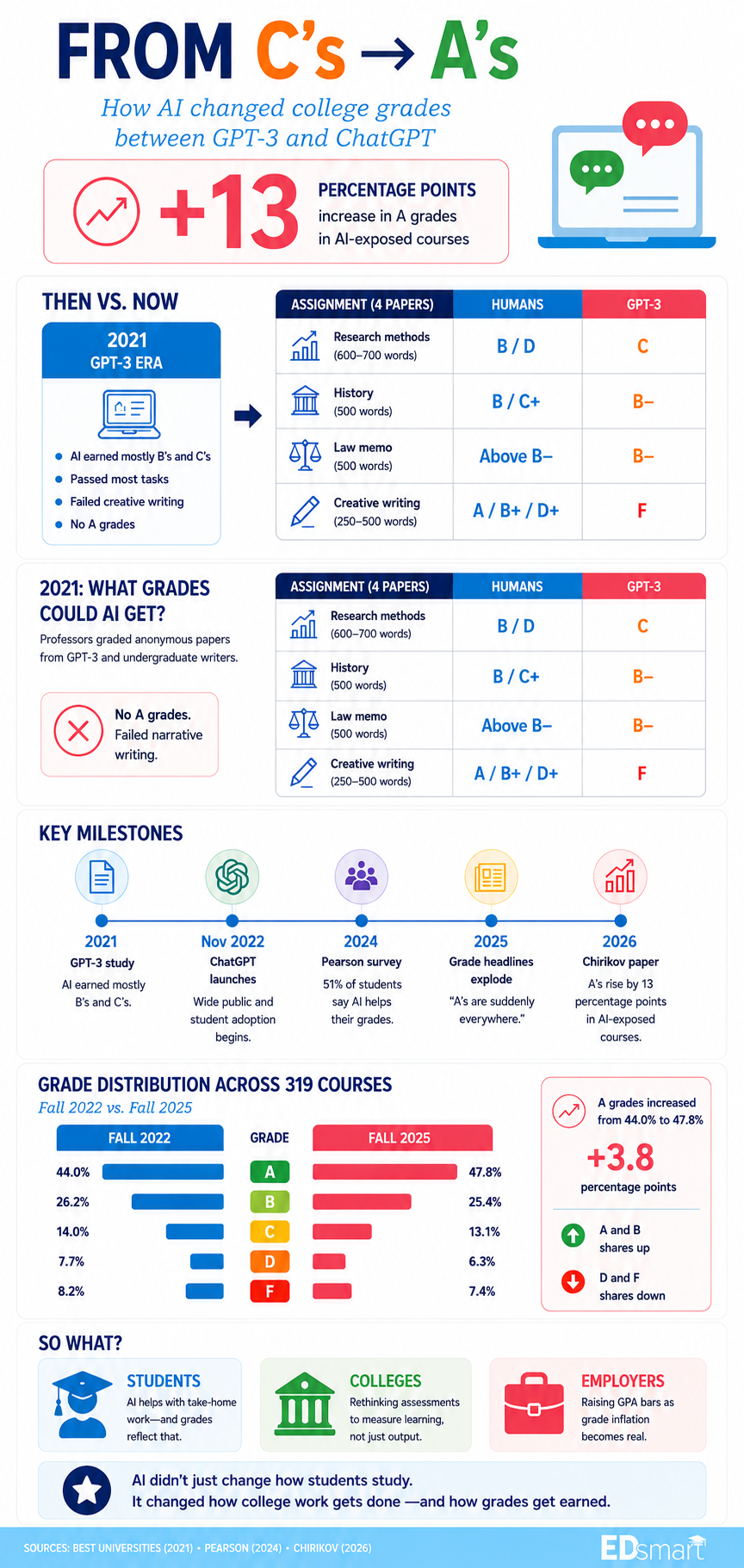
Share this infographic
Full story in one scroll: our 2021 GPT-3 grading experiment, the ChatGPT era, and 2026 transcript research on rising A’s in writing- and homework-heavy courses.
Embed on your site
Copy the HTML below to embed the infographic on your site. The image and credit line must link to this article.