Best Online AI Bachelor’s Degrees (2026)
by EDsmart Staff · Updated August 2026 · Last reviewed August 2026
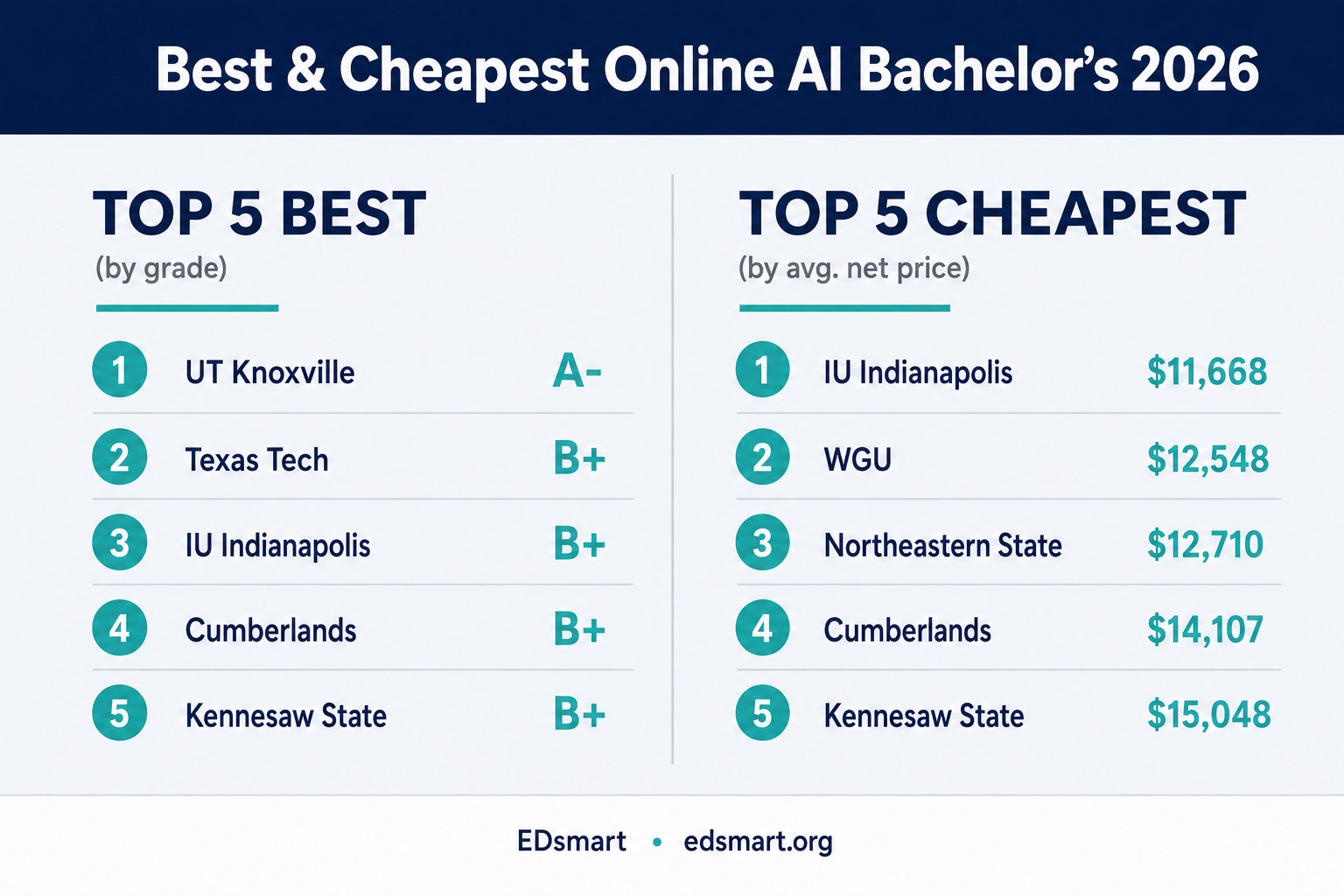
University of Tennessee–Knoxville ranks #1 among the dedicated online AI bachelor’s programs EDsmart evaluated for 2026, based on school-wide student outcomes—not an AI-department ranking. Indiana University Indianapolis has the lowest school-wide average net price in this guide at $11,668 (what typical undergraduates pay after aid). Unlike lists that mix CS concentrations with AI majors, this ranking includes only standalone online AI bachelor’s programs; Western Governors University’s competency-based B.S. AI Engineering (you progress by proving skills, not by seat time) and IU Online’s B.S. in Artificial Intelligence are also worth comparing on our Cheapest list and schools that appear on both lists below.
Key facts
- Scope: Dedicated online AI bachelor’s majors only—not CS or cybersecurity concentrations alone.
- Best by school outcomes: University of Tennessee–Knoxville (A- school-wide grade).
- Lowest school-wide average net price: Indiana University Indianapolis ($11,668).
- On both Top 5 lists: IU Indianapolis, University of the Cumberlands, and Kennesaw State.
Where to start
| If you… | Start here |
|---|---|
| Want the best overall | Top 5 Best |
| Want the lowest cost | Top 5 Cheapest |
| Transfer community college credits | Choose a path · Transfer FAQ |
| Want AI vs CS | AI vs CS comparison |
| Need career info | Careers and pay |
In this article
- Where to start
- Top 5 Best online AI bachelor’s degrees
- Top 5 Cheapest online AI bachelor’s degrees
- How we ranked
- AI vs CS vs data science
- Choose a path that fits
- Program comparison
- What programs have in common
- Other programs to compare
- How to choose
- Accreditation
- Careers and pay
- Frequently asked questions
Top 5 Best online AI bachelor’s degrees
Our top five schools by EDsmart school-wide grade among dedicated online artificial intelligence bachelor’s programs (BS AI, applied AI, and related major titles). Every school below offers a dedicated online AI bachelor’s—not a CS or cybersecurity concentration alone. Kennesaw State’s B.S. in AI is approved for Fall 2026 online launch—confirm enrollment terms on the school’s program page before you apply.
| Rank | School | Location |
|---|---|---|
| 1 | University of Tennessee–Knoxville | Knoxville, TN |
| 2 | Texas Tech University | Lubbock, TX |
| 3 | Indiana University Indianapolis | Indianapolis, IN |
| 4 | University of the Cumberlands | Williamsburg, KY |
| 5 | Kennesaw State University (Fall 2026 launch) | Kennesaw, GA |
University of Tennessee–Knoxville
Online B.S. in Applied Artificial Intelligence (BSAAI)UT Knoxville’s Vols Online BSAAI (College of Emerging and Collaborative Studies) runs 100% online across 120 credits, with no live sessions. Coursework covers AI foundations, ethics and legal issues, data handling and visualization, and applied AI, with optional concentrations or minors and internship options. School-published tuition is about $490 per credit (out-of-state about $565 as of July 2026). Admission typically asks for a 2.0 GPA and at least one post–high school transfer credit.
Primary source: UT Knoxville BSAAI program page
School-wide outcomes
Texas Tech University
Online B.S. in Human-Centered Artificial IntelligenceTexas Tech’s Online+ HCAI bachelor’s is 100% online with no required live sessions (120 credits), with accelerated 8-week courses and multiple start dates. The curriculum blends technology, social sciences, and the arts: programming logic, practical stats, HCAI design, and model foundations, plus paths toward data science, ethical AI and social impact, or UX and AI design. School-published tuition averages about $415–$500 per credit depending on residency.
Primary source: Texas Tech HCAI program page
School-wide outcomes
Indiana University Indianapolis
IU Online B.A. or B.S. in Artificial IntelligenceIU Indianapolis hosts IU Online’s dedicated Artificial Intelligence bachelor’s (100% online, 120 credits). Choose the B.S. for a deeper math and technical foundation or the B.A. for more flexibility. Both aim at data science, machine learning, software, business intelligence, and related roles. IU Online lists up to 64 community-college credits and 90 from a four-year school.
Primary source: IU Online AI bachelor’s page
School-wide outcomes
University of the Cumberlands
Online B.S. in Artificial IntelligenceUniversity of the Cumberlands offers a fully online B.S. in Artificial Intelligence built around machine learning, deep learning, NLP, generative AI, Python, cloud deployment, cybersecurity for AI, and ethics, with project-based work and a capstone. The school lists about 42 major hours at $220 per credit. The bachelor’s still totals 120 credits with general education. A B.A.S. AI option also exists for applied-science students.
Primary source: Cumberlands B.S. AI page
School-wide outcomes
Kennesaw State University
B.S. in Artificial Intelligence (online + Marietta; Fall 2026)Kennesaw State launches its B.S. in Artificial Intelligence in Fall 2026 on the Marietta campus and online (College of Computing and Software Engineering). According to Kennesaw State, adding the B.S. to its existing M.S. in AI (launched 2024) will make it Georgia’s first university to offer both bachelor’s- and graduate-level AI degrees. Middle Georgia State University separately launched a University System of Georgia Applied AI bachelor’s in Fall 2025, so KSU’s claim is about offering both degree levels, not the first AI bachelor’s alone. The curriculum pairs a computing core with a required minor where AI is applied, plus an industry-partner capstone and options for internships or undergraduate research. Check open terms and online seat availability before you apply.
Primary source: KSU B.S. AI announcement
Launch caveat: Online B.S. in AI opens Fall 2026. Ranked on published plans and institutional outcomes; confirm open online terms before you enroll.
School-wide outcomes
On both Top 5 lists: Indiana University Indianapolis, University of the Cumberlands, and Kennesaw State. Strong grade and lower average net price among the dedicated online AI bachelor’s programs featured here.
Top 5 Cheapest online AI bachelor’s degrees
Ranked by average net price after grants and scholarships—what typical undergraduates at each school pay, not the school’s published AI-major tuition.
The lowest school-wide average net price among accredited dedicated online AI bachelor’s options in this guide (lowest to highest). This is not a quality ranking—pair it with the Best-by-grade list and program fit. Competency-based schools such as WGU are ordered by the same federal average-net-price figure; total tuition may differ substantially by time to completion. Kennesaw State carries a Fall 2026 online launch caveat.
| Rank | School | Location | Average Net Price |
|---|---|---|---|
| 1 | Indiana University Indianapolis | Indianapolis, IN | $11,668 |
| 2 | Western Governors University | Salt Lake City, UT | $12,548 |
| 3 | Northeastern State University | Tahlequah, OK | $12,710 |
| 4 | University of the Cumberlands | Williamsburg, KY | $14,107 |
| 5 | Kennesaw State University (Fall 2026 launch) | Kennesaw, GA | $15,048 |
Indiana University Indianapolis
IU Online B.A. or B.S. in Artificial IntelligenceIU Indianapolis leads the Cheapest Top 5 at $11,668 average net price while also ranking #3 Best. IU Online’s AI bachelor’s is fully online (120 credits) with B.A. and B.S. options and transfer-friendly credit caps for community-college and four-year coursework. Run the school’s net price calculator for your aid picture.
Primary source: IU Online AI bachelor’s page
School-wide outcomes
Western Governors University
B.S. AI EngineeringWGU’s competency-based B.S. AI Engineering stacks software engineering, cloud, and model deployment (Python and C# on the program page), with a Microsoft Azure AI Fundamentals cert included in tuition. School-published cost is $4,200 per six-month term, plus resource fees (as of July 2026). Admission is not open enrollment; review current math and programming prerequisites or alternative pathways (including WGU Academy). Faster completion can cut total tuition below what average net price alone implies.
Primary source: WGU AI Engineering program page
School-wide outcomes
Northeastern State University
Online B.S. in Artificial Intelligence and Data AnalyticsNortheastern State (College of Business and Technology) offers a B.S. in Artificial Intelligence and Data Analytics online as well as on its Tahlequah and Broken Arrow campuses. The program mixes theory with hands-on AI and analytics work and ends in an experiential learning project tied to real industry scenarios. Pair the $12,710 average net price with the published course sequence and residency/aid rules before you decide.
Primary source: NSU AI & Data Analytics page
School-wide outcomes
University of the Cumberlands
Online B.S. in Artificial IntelligenceCumberlands posts a $14,107 average net price and a school-published $220 per credit rate on major coursework for its online B.S. in Artificial Intelligence. Curriculum emphasizes building and deploying systems (ML, deep learning, NLP/LLMs, Python, cloud, and AI ethics) through projects and a capstone. Major hours plus general education still add to a 120-credit bachelor’s total.
Primary source: Cumberlands B.S. AI page
School-wide outcomes
Kennesaw State University
B.S. in Artificial Intelligence (online + Marietta; Fall 2026)Kennesaw State closes the Cheapest Top 5 at $15,048 average net price. Its new B.S. in Artificial Intelligence (online and Marietta) builds on an existing CS AI concentration and M.S. in AI, with a required minor, writing-intensive computing coursework, and an applied AI capstone with industry partners. Tuition may change after the program opens; check the current rate when you apply.
Primary source: KSU B.S. AI announcement
Launch caveat: Online B.S. in AI opens Fall 2026. Ranked on published plans and institutional outcomes; confirm open online terms before you enroll.
School-wide outcomes
Published tuition vs average net price: Flat-term pricing (for example WGU’s $4,200 per six-month term) can bring total tuition below average net price if you finish faster. Run each school’s net price calculator for your situation.
How we ranked online AI bachelor’s degrees
We ranked schools that offer a fully online, dedicated AI bachelor’s—an online artificial intelligence degree at the undergraduate level (not CS or cybersecurity concentrations alone). Unlike many competitor lists that mix AI concentrations into “best AI bachelor’s” rankings, we only include schools with a standalone or dedicated bachelor’s-level AI major available online.
We publish two lists from programs that meet those rules: Top 5 Best by EDsmart school-wide grade (then overall rank), and Top 5 Cheapest by school-wide average net price. Grades, retention, graduation, and earnings on school cards are school-wide—not AI-department or AI-graduate outcomes. Cheapest is not the same as Best. Average net price is what undergraduates at that school typically pay after grants and scholarships. It is not the school’s published AI-major tuition, and it is not a personal cost quote.
Competency-based schools such as WGU remain in the Cheapest list using the same federal average-net-price figure as term-based schools; actual total tuition can be lower if you finish faster under flat-term pricing. Figures come from U.S. Department of Education data and EDsmart school profiles unless labeled as school-published tuition. For calculations, see our rankings methodology.
AI vs computer science vs data science
Many people search for an “AI degree” when a computer science or data science bachelor’s may fit better. Use this quick compare before you lock onto a dedicated AI major.
| Degree | Best for | Typical emphasis |
|---|---|---|
| Artificial intelligence | Machine learning, intelligent systems, applied AI product work | Earlier ML, data, ethics, and model/application coursework |
| Computer science | Broad software engineering and systems roles | Algorithms, software design, systems; AI often via electives or a concentration |
| Data science | Analytics and predictive modeling | Statistics, data pipelines, visualization, and applied ML |
Neither AI nor CS is universally “better.” A dedicated AI bachelor’s moves you into machine learning and intelligent systems earlier. A CS bachelor’s (with or without an AI concentration) keeps broader software foundations that many employers still hire against. Data science is the stronger default if your goal is analytics-heavy work rather than building software systems. Match required math and programming to the job you want. CS-only concentrations (for example SNHU’s generative AI cybersecurity track) are not ranked in either Top 5 here.
Choose a path that fits
The Top 5 lists answer who leads on grade and net price. These questions help you match delivery and career focus before you dig into the comparison table.
Three questions
After you scan the ranked lists, use pace, prior credits, and career focus to narrow fit.
1. Preferred learning pace?
- Self-paced / competency-based: WGU B.S. AI Engineering (#2 Cheapest; flat term pricing). Review math and programming admissions requirements before you apply.
- Structured terms (8-week or semester): UT Knoxville, Texas Tech, IU Online, UMGC, and ASU Online.
2. Bringing prior college credits or an associate degree?
- Transfer-heavy / military-friendly: UMGC (up to 90 transfer credits; AI Applications vs AI Developer tracks) and IU Online (up to 64 from a community college and 90 from a four-year).
- Fewer credits or starting fresh: Still compare Best and Cheapest lists. UT Knoxville publishes a 120-credit program; self-paced options bill by term rather than by credit.
3. Build AI systems, or apply AI in business?
- Highly technical (models, engineering, deployment): IU Online B.S. in AI, UTK Applied AI, UMGC Developer track, or WGU AI Engineering.
- Business / managerial AI: ASU Online B.S. Artificial Intelligence in Business (W.P. Carey + ML), or UMGC Applications track.
- Human-centered / UX + AI: Texas Tech HCAI.
Online AI bachelor’s pathway types
Online AI bachelor’s program comparison
Delivery and cost angles for schools on either Top 5, plus ASU and UMGC pathway options. Sorted for comparison, not a third outcomes ranking. For fuller program write-ups, see the school cards above.
| School / program | Grade | Delivery / cost | Best fit |
|---|---|---|---|
| University of Tennessee–KnoxvilleB.S. Applied Artificial Intelligence | A- | Online (no live sessions); about $490/credit (OOS $565) | Best-list leader; applied AI |
| Texas Tech UniversityB.S. Human-Centered Artificial Intelligence | B+ | 100% online (no required live sessions); 8-week classes; about $415–$500/credit | Human-centered / UX + AI |
| Indiana University IndianapolisIU Online B.A. or B.S. in Artificial Intelligence | B+ | Lowest avg. net price in this set ($11,668) | On both Best and Cheapest |
| University of the CumberlandsB.S. in Artificial Intelligence | B+ | About $220/credit on major hours (120-credit total) | On both Best and Cheapest |
| Kennesaw State UniversityB.S. Artificial Intelligence | B+ | Online + Marietta; Fall 2026 launch | On both Best and Cheapest |
| Western Governors UniversityB.S. AI Engineering | B | Flat six-month term; competency-based; #2 cheapest by net price | Self-paced adults; check math/programming gates |
| Northeastern State UniversityB.S. Artificial Intelligence and Data Analytics | B- | Avg. net price $12,710 | Cheapest-list value pick |
| Arizona State University (Digital Immersion)B.S. Artificial Intelligence in Business | C | W.P. Carey + ML/big data; average net price not available | Business analytics / tech managers |
| University of Maryland Global CampusB.S. Artificial Intelligence (Applications or Developer) | C+ | Up to 90 transfer credits; $337 / $499 / $250 per credit (in-state / OOS / military) | Military / transfer-heavy adults |
| Southern New Hampshire UniversityCybersecurity + Generative AI concentration | C | No standalone AI bachelor’s | Concentration only—not a standalone AI major |
Grades vs fit: A strong net-price rank can pair with a mid-range overall grade. Weigh grade alongside course depth, transfer policy, admissions requirements, and your timeline.
What dedicated online AI bachelor’s programs have in common
Across the dedicated online AI bachelor’s programs featured in this guide, a few design patterns show up often when you compare program pages side by side.
- Capstone or culminating project: Six of the nine dedicated majors we feature require a capstone, team project, or similar final project (for example Cumberlands, Kennesaw, WGU, NSU, UMGC, and ASU Online’s business pathway).
- Required minor: Only Kennesaw State requires a minor where AI is applied (Fall 2026 launch).
- No live classes or self-paced study: Six of nine advertise fully online schedules with no required live sessions, or competency-based pacing (UT Knoxville, Texas Tech, IU Online, Cumberlands, WGU, UMGC).
- Ethics / responsible AI: Most dedicated majors include ethics, governance, or human-centered AI coursework—not only model-building electives.
Texas Tech HCAI and IU Online’s AI bachelor’s do not list a formal capstone on their published program pages—check each school’s program page before you assume a portfolio-ready final project is built in.
Other online AI bachelor’s programs to compare
Other directories often list additional dedicated AI bachelor’s degrees. These three also offer standalone AI majors worth checking against our Top 5 lists—they are not ranked in the tables above.
| School | Program | Notes |
|---|---|---|
| Grand Canyon University | B.S. in Artificial Intelligence (online) | Fully online dedicated major; higher typical net price (~$32,702 school-wide avg.) |
| American Public University System | B.S. in Artificial Intelligence (100% online) | Dedicated major with monthly starts and a capstone (ARIN499) |
| Colorado Technical University | B.S. in Artificial Intelligence | Dedicated major listed on CTU’s site—confirm whether yours is offered fully online before you apply |
Primary sources: GCU B.S. AI · APU B.S. AI · CTU B.S. AI program page
Pathway details: engineering, dual-track, and business AI
WGU: AI Engineering
Competency-based six-month terms at a flat published rate, with applied software engineering, cloud, and model deployment. Not open enrollment; check math and programming admissions requirements. Strong Cheapest-list fit; overall grade is B.
UMGC: dual tracks
One B.S. in Artificial Intelligence with an AI Applications track (use AI in workflows) and an AI Developer track (build systems). The program page lists up to 90 transfer credits. Published rates include $337 per credit in-state, $499 out-of-state, and $250 military (as of July 2026). The grade is C+, so pair program fit with cost for your residency status.
ASU Online: AI in Business
W.P. Carey business core plus machine learning and big data. Best when you want managerial or analytics roles, not a pure CS or engineering major. Admission requirements (GPA, test scores, or transfer GPA) apply. Not on either Top 5 (grade C; average net price not available).
How to choose an online AI bachelor’s
Expect math and programming depth. Technical AI bachelor’s programs commonly include calculus, linear algebra, probability, statistics, and Python (sometimes a second language such as C#). Business-oriented AI majors still usually require statistics and programming for analytics. Check the program requirements before you enroll if math was a weak spot.
Responsible AI is part of the job. Many dedicated AI majors now teach ethics, bias, governance, privacy, and responsible AI practices. That matters for hiring and for roles that touch regulated data or public-facing systems. Look for required ethics or human-centered courses, not only model-building electives.
Build proof of work. Employers increasingly expect AI graduates to show project portfolios, GitHub repositories, internships, or undergraduate research, not just a degree title. Prefer programs with capstones, industry projects, or for-credit internship options, and plan portfolio work alongside coursework. Six of the nine dedicated majors featured here require a capstone or similar final project—see program patterns above.
Avoid: unaccredited “AI diplomas,” programs that teach only chat interfaces without programming/math, and borrowing for a short certificate when an accredited bachelor’s from a U.S. Department of Education–recognized school fits. Check StudentAid.gov and each school’s net price calculator. If you already hold a bachelor’s, a master’s in AI or a related field is usually the better next step than a second undergraduate major.
Accreditation matters
Every program highlighted here is offered by an accredited university recognized by the U.S. Department of Education. (Readers who still search for “regionally accredited” are usually looking for that same school-level check.) Accreditation affects credit transfer, graduate school eligibility, employer recognition, and federal student aid. Use the Department’s accreditation database (DAPIP) to confirm the school, then recheck the program page for the exact major and any extra approvals your career path may need. School accreditation does not automatically mean the AI major itself has a separate program approval (for example ABET)—verify that if your employer or licensure path requires it.
What jobs and pay look like after an AI bachelor’s
Graduates commonly start in software development, data science, machine learning support, business analytics, or AI product and solutions roles, then move into more specialized AI engineering as experience builds. Titles vary by employer. A bachelor’s can open many of these doors; research-heavy AI scientist roles more often prefer a master’s or Ph.D.
Earnings on school cards are school-wide, not AI-major salaries. They reflect typical undergraduate outcomes at each school. Use Bureau of Labor Statistics (BLS) occupation medians below for role context—not as pay for graduates of a specific AI program.
Common career paths include machine learning engineer, AI developer, data scientist, AI business analyst, AI product manager, solutions architect, and (in some applied teams) prompt or applied AI specialist roles. Internships and portfolios matter as much as the major name.
Pay context (not school-specific outcomes): According to the U.S. Bureau of Labor Statistics Occupational Outlook Handbook (May 2024 median wages), software developers earned a median of $133,080; data scientists earned $112,590; and computer and information research scientists earned $140,910 (that occupation often lists a master’s as typical entry-level education). Pay varies by occupation, experience, industry, and location. These figures are national medians, not guarantees for AI majors.
FAQ: online AI bachelor’s degrees
What is an online artificial intelligence degree at the bachelor’s level?
An online artificial intelligence degree for undergraduates is a bachelor’s major (often a BS AI or B.S. in Artificial Intelligence) delivered fully or mostly online. Programs teach foundations of AI, data, and programming; some lean engineering (for example WGU’s AI Engineering), applied AI (UT Knoxville’s BSAAI), or business AI. This page ranks dedicated online AI bachelor’s programs—not master’s-only lists and not CS concentrations alone.
What is the best online AI bachelor’s degree?
There is no single best program for every student. UT Knoxville ranks #1 in EDsmart’s 2026 Best list based on school-wide affordability and student outcomes among dedicated online AI bachelor’s programs—it is not a ranking of AI departments or curricula alone. Fit still depends on pace, prior credits, and whether you want engineering, applied, or business AI. Other programs worth comparing include WGU’s competency-based B.S. AI Engineering and IU Online’s B.S. in Artificial Intelligence.
What is the cheapest online AI bachelor’s degree?
Among dedicated online AI bachelor’s schools with a published school-wide average net price, Indiana University Indianapolis leads our Top 5 Lowest Average Net Price at $11,668, followed by WGU ($12,548) and Northeastern State University ($12,710). These figures are school-wide averages of what undergraduates typically pay after aid—not the published tuition rate for the AI major. All schools on both lists are accredited by a U.S. Department of Education–recognized accreditor.
How much does an online bachelor’s in artificial intelligence cost?
Average net price for schools on our Cheapest Top 5 runs from about $11,668 (IU Indianapolis) to $15,048 (Kennesaw State)—what typical undergraduates pay after grants and scholarships, not the school’s published AI-major tuition. Published per-credit rates still vary widely (for example UT Knoxville about $490–$565 per credit and UMGC military rates as low as $250 per credit as of July 2026). Use each school’s net price calculator for your aid picture.
Can I transfer community college credits toward an online AI bachelor’s?
Yes—many accredited online AI bachelor’s programs accept transfer credit, but caps and course matches differ. In this guide, IU Online commonly allows up to 64 credits from a community college and up to 90 from a four-year school; UMGC lists up to 90 transfer credits on its B.S. Artificial Intelligence. UT Knoxville’s BSAAI typically expects at least one post–high school transfer credit for admission. Always confirm transferable courses with the registrar before you enroll.
Is a BS AI the same as a bachelor’s in artificial intelligence?
Yes in intent: “BS AI,” “B.S. in Artificial Intelligence,” and “bachelor’s in artificial intelligence” usually describe the same undergraduate major family. Exact titles differ (Applied AI, AI Engineering, AI & Data Analytics). A B.S. typically carries more math and computing than a B.A.; IU Online offers both. Undergraduate AI programs on this page are bachelor’s pathways, not graduate certificates.
Is computer science better than artificial intelligence?
Neither is universally better. CS is often the safer broad software path; a dedicated AI major is stronger when you specifically want earlier ML and AI systems coursework. Many AI roles still hire CS graduates. Use the AI vs CS vs data science comparison above and the job’s required skills.
Can you get an AI bachelor’s fully online?
Yes. Accredited U.S. universities offer fully online AI bachelor’s programs, including UT Knoxville, Texas Tech, IU Online, Cumberlands, WGU, UMGC, and ASU Online. Check the program page for 100% online vs hybrid delivery. Kennesaw State’s online B.S. in AI is scheduled to open Fall 2026.
Why does accreditation matter for an AI bachelor’s?
School accreditation affects federal student aid, credit transfer, and graduate school eligibility. Confirm the university in the Department’s accreditation database (DAPIP) and read any program-level notes if your career path requires them. See Accreditation matters above.
Are there online BBA programs in artificial intelligence?
A few schools package AI inside a business bachelor’s (for example ASU Online’s business AI pathway via W.P. Carey). Those lean managerial analytics more than pure AI engineering. This guide’s Top 5 lists prioritize dedicated online AI bachelor’s majors; treat BBA-in-AI searches as a business-AI fit check, then compare cost and accreditation against the technical BS AI options above.
Related EDsmart research
- Online AI Degrees hub
- Best AI Degrees (campus majors & Top 30)
- How we rank schools
- AI job risk report
Note: AI curricula change rapidly. Schools may update courses, concentrations, tuition, admissions requirements, and delivery formats from year to year. Check each program page and the Department’s accreditation database before you apply. CS or cybersecurity programs with AI concentrations only (for example SNHU) appear in comparison notes, not either Top 5. Kennesaw State’s online B.S. in AI is scheduled to open Fall 2026—confirm enrollment terms and tuition when applications open.
Sources
EDsmart analysis links to primary program and federal sources below. School-wide grades and average net prices draw on U.S. Department of Education data and EDsmart’s rankings methodology.
Federal and EDsmart data
- EDsmart rankings methodology
- U.S. Department of Education — accreditation database (DAPIP)
- U.S. Department of Education / NCES — outcomes and cost data used in EDsmart grades and average net price
Program and school sources
- University of Tennessee–Knoxville — B.S. Applied Artificial Intelligence (BSAAI)
- Texas Tech University — B.S. Human-Centered Artificial Intelligence
- Indiana University Indianapolis / IU Online — Artificial Intelligence bachelor’s
- University of the Cumberlands — B.S. in Artificial Intelligence
- Kennesaw State University — B.S. in Artificial Intelligence (Fall 2026 launch)
- Western Governors University — B.S. AI Engineering
- Northeastern State University — B.S. AI & Data Analytics
- University of Maryland Global Campus — B.S. Artificial Intelligence
- Arizona State University Online — B.S. Artificial Intelligence in Business
- Southern New Hampshire University — Cybersecurity + Generative AI concentration (comparison only)
- Grand Canyon University — B.S. in Artificial Intelligence
- American Public University — B.S. in Artificial Intelligence
- APUS — B.S. in Artificial Intelligence degree requirements (ARIN499 capstone)
- Colorado Technical University — B.S. in Artificial Intelligence program page
Career pay context
- BLS — Software developers (May 2024 median wage)
- BLS — Data scientists (May 2024 median wage)
- BLS — Computer and information research scientists (May 2024 median wage)
About this guide: Written by EDsmart Staff to help students compare fully online AI bachelor’s programs. We cite institutional and federal sources and do not guarantee admission, cost, or employment outcomes.