Best AI Degrees: Majors & Top Colleges
by EDsmart Staff · Updated July 2026 · Last reviewed July 2026
Best AI degrees are still mostly computer science, data science, and mathematics/statistics, plus dedicated AI majors where they exist. EDsmart ranks a Top 30 of schools with strong AI pathways by overall letter grade using the same factors in our rankings methodology. MIT, Caltech, and Stanford lead; Carnegie Mellon’s pioneering B.S. in AI remains a top research-path choice.
Start here: Still choosing a major? Begin with best degrees for AI and CS vs. AI. Ready to shop campuses? Jump to the Top 30 (MIT #1 by EDsmart grade). This guide focuses on campus pathways; for fully online options, see online AI bachelor’s or online AI master’s.
Fast facts: best AI degrees in 2026
- Best majors for AI careers: Computer Science, Data Science, and Mathematics/Statistics, then dedicated AI / AI Engineering where the curriculum is rigorous.
- Standalone AI bachelor’s degrees are still uncommon among selective campuses; Carnegie Mellon launched the first U.S. B.S. in AI in 2018.
- EDsmart Top 30: MIT (#1 nationally, A+) leads by overall letter grade, ahead of Caltech and Stanford.
- Pay anchors (BLS OOH, May 2024): software developers $133,080 median; computer and information research scientists $140,910 median. Both are growing much faster than average.
In this article
- Choose the right AI degree
- Where should you study?
- Careers & next steps
- Frequently asked questions
Choose the right AI degree
Before comparing schools, decide which educational path best matches the kind of AI work you want to do.
What is the best degree for an AI career?
There is no single best AI degree. For engineering and ML roles, computer science is still the most versatile undergraduate bet. For analytics-heavy jobs, data science fits. For research and modeling, mathematics or statistics builds the theory behind modern ML.
Dedicated artificial intelligence or AI Engineering majors help when you want earlier ML, NLP, computer vision, ethics, and MLOps coursework. Program quality varies, though. Many AI majors are new.
| Degree / major | Best for | Watch-outs |
|---|---|---|
| Computer Science | AI engineer, ML engineer, software + AI product roles; maximum flexibility | Competitive programs; you may need AI electives/projects to specialize |
| Artificial Intelligence / AI Engineering | Students certain they want AI systems, NLP, vision, or MLOps | Curriculum depth and employer recognition still vary by school |
| Data Science | Data scientist, applied ML, analytics-heavy AI work | May need stronger systems/software depth for some engineering roles |
| Mathematics / Statistics | Research, quantitative modeling, theory-heavy ML | Usually needs intentional programming/portfolio work |
| Software / Computer Engineering | Production systems, embedded/robotics, AI in products | May need extra ML coursework for research titles |
Choose a degree
What's your goal?
Figure. Choose a degree path for AI careers.
Looking specifically for online AI bachelor’s programs? See our Best Online AI Bachelor’s Degrees guide, or jump to the online note below. Already hold a bachelor’s? Compare Best Online Master’s in AI.
Remember: Treat “AI degree” as three different products in the market.
- Standalone AI / AI Engineering bachelor’s: the degree title is Artificial Intelligence (or AI Engineering).
- Concentration / track inside CS or engineering: still the most common path at research-intensive campuses.
- Minor or business “AI” branding: useful add-on, usually not enough alone for ML-engineer roles.
Related majors, including cybersecurity, cognitive science, robotics, computational linguistics, biomedical engineering, and business analytics, can also lead to AI careers when paired with projects and internships.
Computer science vs. AI major: which should you pick?
Pick computer science if you want the broadest job market, graduate-school optionality, and a foundation that still works if “AI” job titles morph. Add ML electives, research, and a portfolio. On many elite campuses, the “best AI” undergrad experience is still a CS major with an AI track, not a separate diploma title.
Pick a dedicated AI / AI Engineering major if the curriculum is quantitatively serious (linear algebra, probability, ML systems), not a survey of chat tools, and you specifically want earlier NLP/vision/MLOps depth. Because AI majors are newer, compare syllabi against a strong CS program course-by-course.
Also weigh labor-market nuance: a CS credential is still the common technical floor, but outcomes depend on skills and domain context, not the word “AI” alone. Pair tech depth with an application area when you can. For broader AI labor risk and resilience, see our AI job risk report and AI-resistant jobs report.
How to evaluate a new AI major
Dedicated AI bachelor’s degrees scaled up after Carnegie Mellon’s 2018 launch. Many catalogs still put AI inside CS. Before you commit to a new AI-titled major, check:
- Regional institutional accreditation in DAPIP (there is no separate “AI program accreditation” that replaces this).
- Math and systems core: linear algebra, probability/statistics, data structures, and at least one systems or software-engineering course (not only generative-AI tooling).
- Faculty and labs: active ML/AI research groups, undergrad research access, and clear ethics/society coursework.
- Sibling CS quality: if the school’s CS program is strong (and ABET-accredited where relevant), an AI track inside CS can beat a thin standalone AI major.
- Outcomes context: EDsmart overall grade, average net price after grants, and published career reports beat marketing slogans.
Dedicated AI bachelor’s examples in or near our Top 30: MIT (AI and Decision Making), Carnegie Mellon (B.S. AI), University of Pennsylvania (BSAI), UC San Diego, USC, Illinois Tech, and Purdue’s AI pathways. Many other Top 30 schools deliver AI primarily as a CS concentration (Stanford, Berkeley, Georgia Tech’s Intelligence thread, UT Austin’s ML/AI concentration). This guide focuses on campus pathways; for fully online bachelor’s programs, see Best Online AI Bachelor’s Degrees.
Do you need an AI degree to work in AI?
Not necessarily. Many practitioners entered AI through computer science, engineering, math, or data science, then specialized on the job or in graduate school. An AI-titled degree is most useful when you want structured ML coursework earlier or a clearer specialized signal on the transcript.
Employers still filter on skills: programming, ML fundamentals, shipped projects, and increasingly responsible AI judgment. Treat any degree as the floor, not the entire case for hire.
Where AI degrees are growing in the U.S.
Dedicated AI bachelor’s degrees are still a recent invention. Carnegie Mellon’s School of Computer Science announced the nation’s first undergraduate AI major in 2018; many schools still deliver AI as a concentration inside computer science or engineering.
High research AI capacity clusters at research-intensive campuses. The Carnegie Classifications label Research 1 institutions by research spending and doctorate production (2025 threshold: at least $50 million in annual research spending and 70 research doctorates). Those R1 campuses still dominate many AI college rankings. For school-level R&D dollars, use NSF’s HERD Survey from NCSES.
Regional ecosystems also matter for internships and research computing. Examples include NSF National AI Research Institutes and consortia such as New York’s Empire AI.
Practical takeaway: If you want research brand and lab access, shortlist R1 AI and CS programs and verify HERD-scale research strength. Then use the school ranking below to narrow by EDsmart outcomes.
Where should you study?
How we ranked the best AI degree schools
Once you know which major path fits, use this Top 30 to shortlist schools. Schools with dedicated AI or AI Engineering bachelor’s degrees, or clear CS→AI undergrad tracks, are ordered by EDsmart overall letter grade, then composite score. That is the same system on our school profiles and in how we rank schools (completion, affordability, student support, and career outcomes). Fully online options are covered in our online AI bachelor’s and online AI master’s guides.
List position is rank on this Top 30 by EDsmart overall letter grade, not the school’s national rank in our full database.
Editorial note: Program names and delivery modes change. Confirm each catalog and DAPIP listing before you apply. Overall grades, national ranks, and average net prices match the current EDsmart school profiles linked below.
EDsmart Top 30 AI Schools
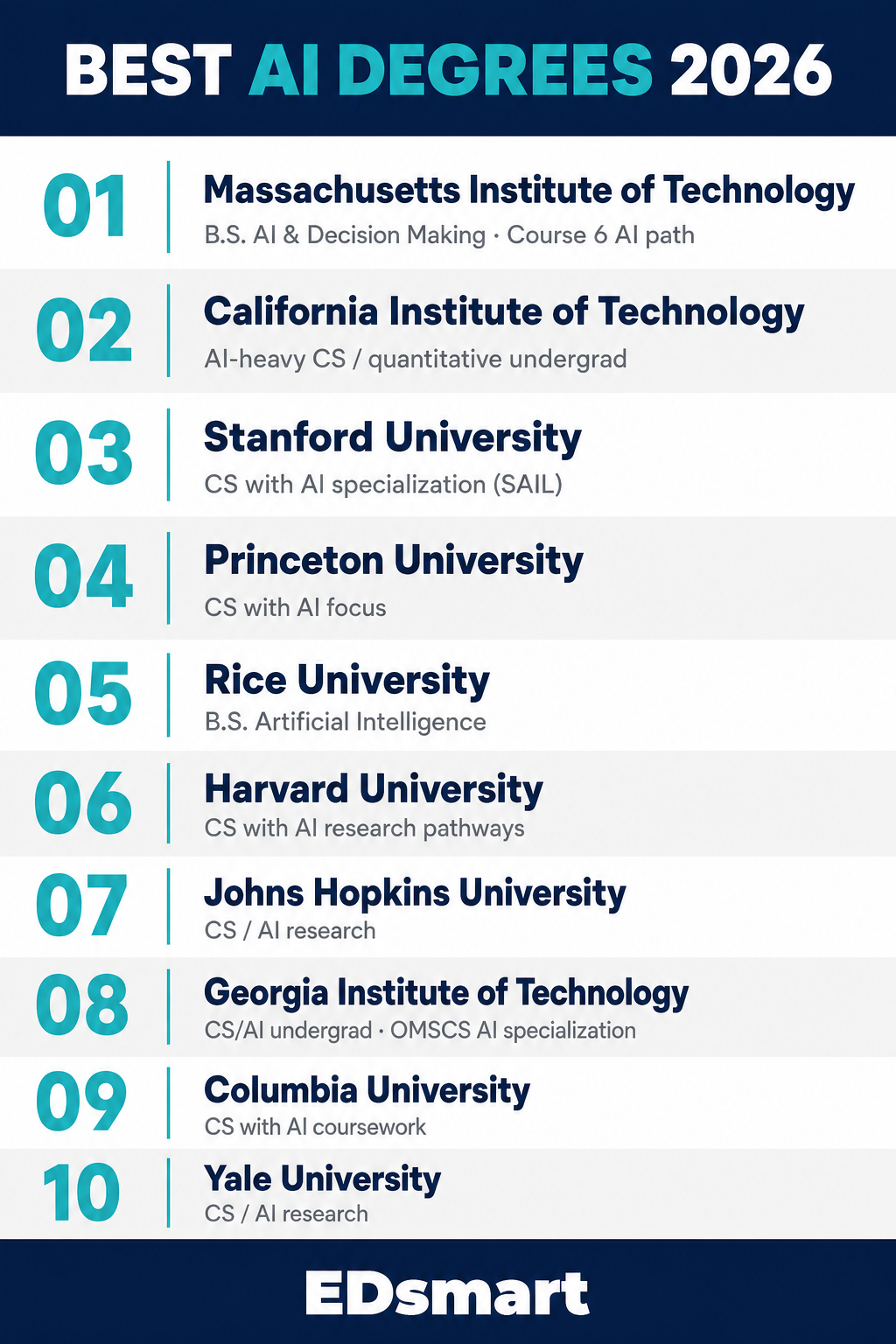
MIT leads this Top 30, sorted by EDsmart overall letter grade (composite as tiebreaker). Grades match our school profiles.
| Rank | School | Overall grade | National rank | Avg. net price | AI pathway type |
|---|---|---|---|---|---|
| 1 | Massachusetts Institute of TechnologyB.S. AI and Decision Making / Course 6 AI path | A+ | #1 | $20,111 | Dedicated + CS AI |
| 2 | California Institute of TechnologyAI-heavy CS/quant undergrad | A+ | #2 | $16,075 | CS AI path |
| 3 | Stanford UniversityCS with AI specialization (SAIL) | A+ | #3 | $13,807 | CS AI path |
| 4 | Princeton UniversityCS with AI focus | A+ | #5 | $6,128 | CS AI path |
| 5 | Rice UniversityB.S. Artificial Intelligence | A+ | #6 | $13,370 | Dedicated AI |
| 6 | Harvard UniversityCS with AI research pathways | A+ | #7 | $19,066 | CS AI path |
| 7 | Johns Hopkins UniversityCS/AI research | A+ | #8 | $18,809 | CS AI path |
| 8 | Georgia Institute of TechnologyCS/AI undergrad; OMSCS AI specialization | A+ | #9 | $12,116 | CS/AI + online MS |
| 9 | Columbia UniversityCS with AI coursework | A+ | #11 | $21,590 | CS AI path |
| 10 | Yale UniversityCS / AI research | A+ | #12 | $23,777 | CS AI path |
| 11 | University of MichiganCS&E Artificial Intelligence track | A+ | #13 | $13,138 | CS AI track |
| 12 | Carnegie Mellon UniversityB.S. Artificial Intelligence | A+ | #14 | $31,944 | Dedicated AI |
| 13 | University of PennsylvaniaCS / AI pathway | A+ | #15 | $28,699 | CS AI path |
| 14 | Duke UniversityCS with AI/ML coursework | A+ | #17 | $29,612 | CS AI path |
| 15 | Northwestern UniversityCS / AI research | A+ | #19 | $29,167 | CS AI path |
| 16 | University of California, BerkeleyCS / AI research strength | A+ | #22 | $13,481 | CS AI path |
| 17 | University of FloridaComputing / AI Across the Curriculum | A+ | #24 | $6,541 | CS + AI curriculum |
| 18 | Cornell UniversityCS/AI research undergrad | A+ | #34 | $28,690 | CS AI path |
| 19 | University of California, San DiegoB.S. Artificial Intelligence | A+ | #40 | $12,470 | Dedicated AI |
| 20 | University of California, Los AngelesCS with AI/ML depth | A+ | #41 | $12,548 | CS AI path |
| 21 | Brown UniversityCS with AI focus | A+ | #44 | $25,184 | CS AI path |
| 22 | University of California, IrvineCS/CSE AI specialization | A | #50 | $14,251 | CS AI path |
| 23 | University of Maryland, College ParkCS AI/ML focus | A | #51 | $15,678 | CS AI path |
| 24 | University of Southern CaliforniaB.S. Artificial Intelligence | A | #53 | $32,740 | Dedicated AI |
| 25 | Purdue UniversityBS CS with AI electives | A | #59 | $14,600 | CS AI path |
| 26 | University of Texas at AustinCS AI/ML concentration; online M.S. AI | A | #61 | $19,857 | CS/AI + online MS |
| 27 | University of Illinois Urbana-ChampaignAI/CS research undergrad | A | #62 | $14,355 | CS AI path |
| 28 | University of WashingtonAllen School AI pathway | A | #79 | $14,091 | CS AI path |
| 29 | University of California, Santa BarbaraCS AI/ML; B.S. AI launching | A | #86 | $16,109 | CS/AI |
| 30 | Illinois Institute of TechnologyB.S. Artificial Intelligence | A | #89 | $18,425 | Dedicated AI |
Average net price is what students typically pay after grants at the institution, not AI-major-specific tuition.
What if you want to study AI fully online?
This guide focuses on campus pathways. For fully online bachelor’s programs (WGU, UMGC, IU Online), see Best Online AI Bachelor’s Degrees. For online master’s (UT Austin MSAI, OMSCS, CU Boulder), see Best Online Master’s in AI.
That bachelor’s guide ranks dedicated online AI programs by overall grade and average net price (Top 5 Best and Top 5 Cheapest). Mid-tier EDsmart grades at online specialists are not automatic red flags: sparse completion data can pull letter grades down even when the credential is institutionally accredited.
Careers & next steps
What AI careers actually pay
Job titles still shift (AI engineer, ML engineer, NLP engineer, AI product manager). Use BLS occupations as pay/demand anchors:
| Role cluster | BLS anchor | Median pay (May 2024) | Outlook |
|---|---|---|---|
| Applied software / AI engineering | Software developers | $133,080 | 15% growth projected 2024–34 |
| Data-centric AI / ML | Data scientists | $112,590 | 34% growth projected 2024–34 |
| Research / advanced AI science | Computer & information research scientists | $140,910 | Much faster than average; master’s often typical |
For students weighing whether an AI path is worth the debt, pair school earnings and cost data with our most useless degrees analysis, not viral salary claims.
AI courses and certificates vs. degrees
Platform courses (for example, popular AI introductions and professional certificates on Coursera’s AI catalog) are useful for literacy and employer-funded upskilling. They rarely replace a regionally accredited degree for first-time undergrads or for roles that hard-filter on a bachelor’s. Use them to test interest, stack into credit when a university path is formal, or fill gaps after a CS/AI degree. Do not treat them as a substitute for math and systems foundations.
| Choose a course/certificate when… | Choose a degree when… |
|---|---|
| You already have a degree and need a targeted skill (prompting, RAG, Azure ML, etc.) | You need a first credential or a career-change signal employers recognize |
| Your employer funds short programs | You need federal student aid for a full credential |
| You’re testing whether you enjoy ML before a multi-year commitment | You need structured CS/math foundations and a transcript |
How to choose your AI path
MIT · Caltech · Stanford · CMU · GT
Lead or near the top of our Top 30 by overall letter grade. Expect selective admissions and strong research ecosystems.
CMU · MIT · Rice · UCSD · USC
Formal AI-named majors with research ecosystems. Still compare syllabi against a strong CS program at the same school.
Online AI bachelor’s & online AI master’s
Cost, competency-based pacing, and delivery mode comparisons live on those guides, not in this Top 30.
Avoid: unaccredited “AI diplomas,” curricula that teach only chat interfaces without math/programming, and borrowing for a low-ROI certificate if a stronger degree path is available. Check StudentAid.gov and each school’s net price calculator.
Frequently asked questions
FAQ: best AI degrees
What is the best degree in AI?
For most technical AI careers, computer science is still the safest undergraduate choice. Dedicated AI or AI Engineering degrees can be excellent when the school’s curriculum is rigorous. Data science and mathematics/statistics fit data- and research-heavy paths.
What college major is best for AI?
Computer science is the most common recommendation for engineers. Pair it with ML electives and projects. Choose a standalone AI major only after comparing syllabi with a strong CS program.
What are the best colleges for artificial intelligence?
On EDsmart’s Top 30 (overall letter grade), MIT, Caltech, and Stanford lead, with Rice, Harvard, Johns Hopkins, Georgia Tech, and Carnegie Mellon also near the top.
Is computer science or an AI degree better?
Computer science is usually broader and more established. An AI degree wins when you want earlier specialization and the program’s math/systems core is strong. Hiring managers still often prefer CS for ML engineer paths.
Can you earn an AI degree fully online?
Yes. Several regionally accredited online AI bachelor’s and master’s programs exist. This guide focuses on campus pathways; compare online AI bachelor’s (WGU, UMGC, IU Online) or online AI master’s (UT Austin MSAI, OMSCS, CU Boulder).
Are AI degrees worth it?
They can be, if the program is regionally accredited, quantitatively serious, and priced for the outcome you want. Selective campus AI/CS degrees trade cost and selectivity for research brand and labs.
Do I need a master’s degree for AI?
Not always for applied software/ML roles if you have strong CS foundations and a portfolio. A master’s is more common for research-scientist tracks and for career changers who need structured depth.
What math do you need for an AI major?
Expect linear algebra, calculus, and probability/statistics, plus programming and data structures. Weak math is the most common reason “AI” marketing curricula fail to convert into ML-engineer readiness.
Do degrees that will “survive AI” matter more than an AI degree?
If your question is career resilience rather than becoming an AI builder, start with our AI-resistant jobs and most-useless-degrees coverage. Then decide whether an AI credential is the goal or a tool.
Related EDsmart research
- How we rank schools
- Best Online AI Bachelor’s Degrees
- Best Online Master’s in AI
- Online AI Degrees hub
- AI job risk report
- AI-resistant jobs report
- AI college grades: 2021 vs. 2026
- Most useless degrees
Sources
This guide draws on EDsmart school rankings and profiles, federal education and labor data, research classifications, and institutional program pages. Full methodology details appear on our rankings methodology page.
- EDsmart rankings and school profiles (overall grades, national ranks, and average net prices)
- U.S. Bureau of Labor Statistics, Occupational Outlook Handbook: Software Developers; Data Scientists; Computer and Information Research Scientists (May 2024 wages; 2024–34 projections)
- U.S. Department of Education, Database of Accredited Postsecondary Institutions and Programs (DAPIP)
- U.S. Department of Education / NCES, Integrated Postsecondary Education Data System (IPEDS)
- Carnegie Classification of Institutions of Higher Education (2025 Research Activity Designations)
- National Science Foundation / NCSES, Higher Education Research and Development (HERD) Survey
- Carnegie Mellon University School of Computer Science, launch of the first U.S. undergraduate AI degree (2018)
- New York State Empire AI consortium
- Institutional program pages reviewed July 2026, including MIT Artificial Intelligence and Decision Making; Western Governors University B.S. AI Engineering; University of Maryland Global Campus B.S. Artificial Intelligence; Georgia Tech OMSCS; UT Austin online M.S. in Artificial Intelligence; University of Illinois Urbana-Champaign MCS–AI; and Eastern University M.S. in Applied AI
About this guide: Written by EDsmart Staff to help students compare AI majors and programs. We cite institutional and federal sources and do not guarantee admission, cost, or employment outcomes.